


Page 146 - Review of Medical Microbiology and Immunology ( PDFDrive )
P. 146
mebooksfree.com
 mebooksfree.com


                                                                                                                                           mebooksfree.com
            mebooksfree.com
                                                                                                            mebooksfree.com
                                            mebooksfree.com
                                                                            mebooksfree.com
 mebooksfree.com  mebooksfree.com           mebooksfree.com                 mebooksfree.com         C   H  A   P  T  E   R                 mebooksfree.com
                                                                                                    17


                    Gram-Positive Rods


                                                                            mebooksfree.com
 mebooksfree.com  mebooksfree.com           mebooksfree.com              Listeria monocytogenes             mebooksfree.com                mebooksfree.com

                       CHAPTER  C ONTENT S

                       Introduction
                                                                         Gardnerella vaginalis
                       SPORE-FORMING GRAM-POSITIVE RODS
                       Bacillus
                                                                         Self-Assessment Questions
                       Clostridium
                                                                         Summaries of Organisms
                       NON–SPORE-FORMING GRAM-POSITIVE RODS
                                                                         Practice Questions: USMLE & Course Examinations
                       Corynebacterium diphtheriae

                                                                            mebooksfree.com
                                                                                                            mebooksfree.com
 mebooksfree.com  mebooksfree.com           mebooksfree.com              Clostridium species are longer and more deeply staining than      mebooksfree.com
                        INTRODUCTION
                                                                         Corynebacterium and  Listeria species.  Corynebacterium
                        There are five medically important genera of gram-positive
                                                                         species are club-shaped (i.e., they are thinner on one end
                        rods: Bacillus, Clostridium, Corynebacterium, Listeria, and
                                                                         than the other). Corynebacterium and Listeria species char-
                        Gardnerella. Bacillus and Clostridium form spores, whereas
                                                                         acteristically appear as V- or L-shaped rods.  Gardnerella
                        Corynebacterium, Listeria, and Gardnerella do not. Members
                                                                         vaginalis is a short gram-variable rod.
                        of the genus Bacillus are aerobic, whereas those of the genus
                                                                           Additional information regarding the clinical aspects of
                        Clostridium are anaerobic (Table 17–1).
                                                                         infections caused by the organisms in this chapter is provided
                          These gram-positive rods can also be distinguished
                                                                         in Part IX entitled Infectious Diseases beginning on page 593.
                        based on their appearance on Gram stain.  Bacillus and
 mebooksfree.com  mebooksfree.com           mebooksfree.com              1. Bacillus anthracis              mebooksfree.com                mebooksfree.com
                                                                            mebooksfree.com
                        SPORE-FORMING GRAM-POSITIVE RODS

                        BACILLUS
                                                                         Disease
                        There are two medically important Bacillus species: Bacillus
                        anthracis and Bacillus cereus. Important features of pathogen-
                                                                         Bacillus anthracis causes anthrax (Figure 17–1), which is
                        esis by these two Bacillus species are described in Table 17–2.
                                                                         common in animals but rare in humans. Human disease
                                                                         occurs in three main forms: cutaneous, pulmonary (inhala-
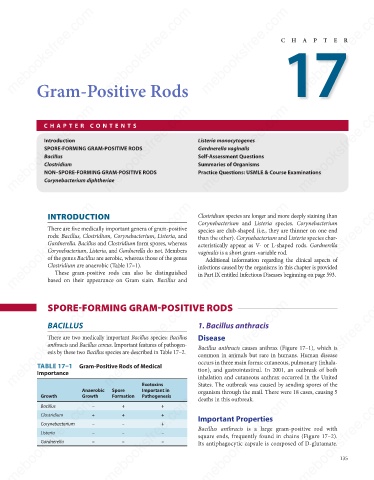
                    TABLE 17–1  Gram-Positive Rods of Medical
                    Importance
                                                                         inhalation and cutaneous anthrax occurred in the United
                                                                         States. The outbreak was caused by sending spores of the
                                                       Important in
                                   Anaerobic   Spore   Exotoxins         tion),  and gastrointestinal. In 2001, an outbreak of  both
                                                                         organism through the mail. There were 18 cases, causing 5
                      Growth
                                                       Pathogenesis
                                             Formation
                                   Growth
 mebooksfree.com  mebooksfree.com     – – – mebooksfree.com              Important Properties               mebooksfree.com                mebooksfree.com
                                                                            mebooksfree.com
                                                                         deaths in this outbreak.
                                                             +
                                      –
                                                +
                      Bacillus
                      Clostridium
                                                +
                                                             +
                                      +
                                                –
                      Corynebacterium
                                                             +
                                                                         Bacillus anthracis is a large gram-positive rod with
                                                             –
                      Listeria
                                                –
                                                                         square ends, frequently found in chains (Figure 17–2).
                                                             –
                                                –
                      Gardnerella
                                                                         Its antiphagocytic capsule is composed of D-glutamate.
                                                                                                                       135
 mebooksfree.com  mebooksfree.com           mebooksfree.com                 mebooksfree.com                 mebooksfree.com                mebooksfree.com

