


Page 275 - Review of Medical Microbiology and Immunology ( PDFDrive )
P. 275
mebooksfree.com


                                                                            mebooksfree.com
                                                                                                                                           mebooksfree.com
            mebooksfree.com
 mebooksfree.com  mebooksfree.com           mebooksfree.com                 mebooksfree.com                 mebooksfree.com                mebooksfree.com
                                            mebooksfree.com
                                                                                                            mebooksfree.com
                 264
                       PART III  Basic Virology
                    releasing proteolytic  enzymes called  granzymes into the
                    infected cell, which degrade the cell contents; and (3) by
                    activating the FAS protein, which causes programmed cell
                    death (apoptosis).
                       Not all virus infections induce antibodies. Tolerance
                    to viral antigens can occur when the virus infection
                    develops in a fetus or newborn infant. The model system
                    in which tolerance has been demonstrated is lympho-
                    cytic choriomeningitis (LCM) infection in mice. If LCM
 mebooksfree.com  mebooksfree.com           mebooksfree.com                 mebooksfree.com                 mebooksfree.com                mebooksfree.com
                    virus is inoculated into a newborn mouse, the virus
                    replicates widely, but no antibodies are formed during
                    the lifetime of the animal. The virus is recognized as
                    “self,” because it was present at the time of maturation of
                    the immune system. If LCM virus is given to an adult
                    mouse, antibodies are formed normally. There is no
                    example of total tolerance to a virus in humans; even in
                    congenital rubella syndrome, in which the virus infects
                    the fetus, some antibody against rubella virus is made.
                    However, virus production and shedding can go on for
                    months or years.
                       Suppression of the cell-mediated response can occur
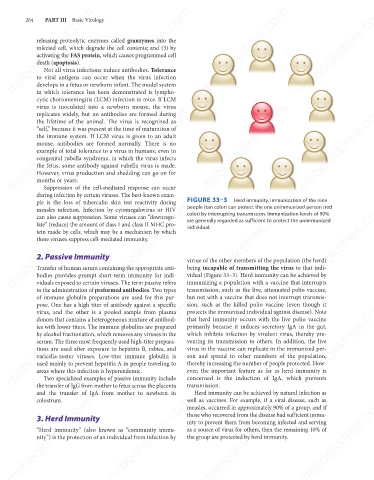
                    during infection by certain viruses. The best-known exam-  FIGURE 33–3   Herd immunity. Immunization of the nine
                    ple is the loss of tuberculin skin test reactivity during
                                                                                                            mebooksfree.com
                                                                            mebooksfree.com
 mebooksfree.com  mebooksfree.com           mebooksfree.com          are generally regarded as sufficient to protect the unimmunized       mebooksfree.com
                                                                     people (tan color) can protect the one unimmunized person (red
                    measles infection. Infection by cytomegalovirus or HIV
                                                                     color) by interrupting transmission. Immunization levels of 90%
                    can also cause suppression. Some viruses can “downregu-
                    late” (reduce) the amount of class I and class II MHC pro-
                                                                     individual.
                    tein made by cells, which may be a mechanism by which
                    these viruses suppress cell-mediated immunity.
                    2. Passive Immunity
                                                                     virtue of the other members of the population (the herd)
                    Transfer of human serum containing the appropriate anti-
                                                                     being incapable of transmitting the virus to that indi-
                    bodies provides prompt short-term immunity for indi-
                                                                     immunizing a population with a vaccine that interrupts
                    viduals exposed to certain viruses. The term passive refers
                                                                     transmission, such as the live, attenuated polio vaccine,
                    to the administration of preformed antibodies. Two types
                                                                     but not with a vaccine that does not interrupt transmis-
                    of immune globulin preparations are used  for this pur-  vidual (Figure 33–3). Herd immunity can be achieved by
 mebooksfree.com  mebooksfree.com           mebooksfree.com          transmission. mebooksfree.com          mebooksfree.com                mebooksfree.com
                    pose. One has a high titer of antibody against a specific
                                                                     sion, such as the killed polio vaccine (even though it
                    virus, and the other is a pooled sample from plasma
                                                                     protects the immunized individual against disease). Note
                    donors that contains a heterogeneous mixture of antibod-
                                                                     that herd immunity occurs with the live polio vaccine
                    ies with lower titers. The immune globulins are prepared
                                                                     primarily because it induces secretory IgA in the gut,
                                                                     which inhibits infection by virulent virus, thereby pre-
                    by alcohol fractionation, which removes any viruses in the
                                                                     venting its transmission to others. In addition, the live
                    serum. The three most frequently used high-titer prepara-
                                                                     virus in the vaccine can replicate in the immunized per-
                    tions are used after exposure to hepatitis B, rabies, and
                                                                     son and spread to other members of the population,
                    varicella-zoster viruses. Low-titer immune globulin is
                    used mainly to prevent hepatitis A in people traveling to
                                                                     thereby increasing the number of people protected. How-
                    areas where this infection is hyperendemic.
                                                                     concerned is the induction of IgA, which prevents
                       Two specialized examples of passive immunity include
                    the transfer of IgG from mother to fetus across the placenta
                    and  the  transfer  of  IgA  from  mother  to  newborn  in   ever, the important feature as far as herd immunity is
                                                                        Herd immunity can be achieved by natural infection as
                                                                            mebooksfree.com
                                                                                                            mebooksfree.com
 mebooksfree.com  mebooksfree.com           mebooksfree.com          nity to prevent them from becoming infected and serving               mebooksfree.com
                    colostrum.
                                                                     well as vaccines. For example, if a viral disease, such as
                                                                     measles, occurred in approximately 90% of a group, and if
                                                                     those who recovered from the disease had sufficient immu-
                    3. Herd Immunity
                    “Herd immunity” (also known as “community immu-
                                                                     as a source of virus for others, then the remaining 10% of
                                                                     the group are protected by herd immunity.
                    nity”) is the protection of an individual from infection by
 mebooksfree.com  mebooksfree.com           mebooksfree.com                 mebooksfree.com                 mebooksfree.com                mebooksfree.com

