Page 272 - Review of Medical Microbiology and Immunology ( PDFDrive )
P. 272
mebooksfree.com
                                                                            mebooksfree.com
 mebooksfree.com

            mebooksfree.com
                                            mebooksfree.com
                                                                            mebooksfree.com
                                                                                                                                           mebooksfree.com
                                                                                                            mebooksfree.com
 mebooksfree.com  mebooksfree.com   Virus  A mebooksfree.com         B  Antiviral  infection  CHAPTER 33  Host Defenses  261               mebooksfree.com
                                              Interferon
                                                                                                    Viral mRNA
                                             molecules
                                                                        proteins
                                                                                  Viral


                                                                                                  C
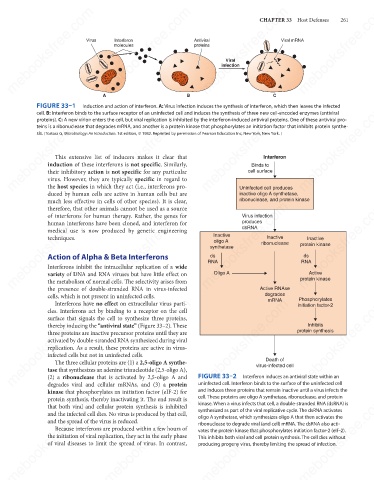
                    FIGURE 33–1
 mebooksfree.com  mebooksfree.com           mebooksfree.com                 mebooksfree.com                 mebooksfree.com                mebooksfree.com
                                   Induction and action of interferon. A: Virus infection induces the synthesis of interferon, which then leaves the infected
                    cell. B: Interferon binds to the surface receptor of an uninfected cell and induces the synthesis of three new cell-encoded enzymes (antiviral
                    proteins). C: A new virion enters the cell, but viral replication is inhibited by the interferon-induced antiviral proteins. One of these antiviral pro-
                    teins is a ribonuclease that degrades mRNA, and another is a protein kinase that phosphorylates an initiation factor that inhibits protein synthe-
                    sis. (Tortora G, Microbiology: An Introduction. 1st edition, © 1982. Reprinted by permission of Pearson Education Inc, New York, New York. )


                          This extensive list of inducers makes it clear that
                                                                                              Interferon
                        induction of these interferons is not specific. Similarly,
                                                                                          Binds to
                        their inhibitory action is not specific for any particular
                                                                                         cell surface
                        virus. However, they are typically  specific in regard to
                        the host species in which they act (i.e., interferons pro-
                        duced by human cells are active in human cells but are         Uninfected cell produces
                                                                                       inactive oligo A synthetase,
                                                                                       ribonuclease, and protein kinase
                        much less effective in cells of other species). It is clear,
 mebooksfree.com  mebooksfree.com           mebooksfree.com                 mebooksfree.com               protein kinase                   mebooksfree.com
                                                                                             Active RNAse mebooksfree.com
                        therefore, that other animals cannot be used as a source
                        of interferons for human therapy. Rather, the genes for
                                                                                       Virus infection
                                                                                       produces
                        human interferons have been cloned, and interferon for
                                                                                       dsRNA
                        medical use is now produced by genetic engineering
                                                                              Inactive
                        techniques.
                                                                                               Inactive
                                                                                                             Inactive
                                                                              oligo A
                                                                                              ribonuclease
                                                                             synthetase
                        Action of Alpha & Beta Interferons
                                                                             ds
                                                                                                            ds
                                                                                                           RNA
                                                                            RNA
                        Interferons  inhibit  the  intracellular  replication  of  a  wide
                                                                                                             Active
                        variety of DNA and RNA viruses but have little effect on
                                                                                                          protein kinase
                        the metabolism of normal cells. The selectivity arises from
                        the presence of double-stranded RNA in virus-infected
                        cells, which is not present in uninfected cells.      Oligo A          degrades   initiation factor-2
                                                                                                          Phosphorylates
                                                                                                            mebooksfree.com
                                                                                                mRNA
 mebooksfree.com  mebooksfree.com           mebooksfree.com                 mebooksfree.com              protein synthesis                 mebooksfree.com
                          Interferons have no effect on extracellular virus parti-
                        cles. Interferons act by binding to a receptor on the cell
                        surface that signals the cell to synthesize three proteins,
                                                                                                             Inhibits
                        thereby inducing the “antiviral state” (Figure 33–2). These
                        three proteins are inactive precursor proteins until they are
                        activated by double-stranded RNA synthesized during viral
                        replication. As a result, these proteins are active in virus-
                        infected cells but not in uninfected cells.
                                                                                               Death of
                          The three cellular proteins are (1) a 2,5-oligo A synthe-
                                                                                            virus-infected cell
                        tase that synthesizes an adenine trinucleotide (2,5-oligo A),
                        (2) a  ribonuclease that is activated by 2,5-oligo A and
                        degrades viral and cellular mRNAs, and (3) a  protein
                                                                         uninfected cell. Interferon binds to the surface of the uninfected cell
                                                                         and induces three proteins that remain inactive until a virus infects the
                        kinase that phosphorylates an initiation factor (eIF-2) for   FIGURE 33–2   Interferon induces an antiviral state within an
                                                                         cell. These proteins are oligo A synthetase, ribonuclease, and protein
 mebooksfree.com  mebooksfree.com           mebooksfree.com              oligo A synthetase, which synthesizes oligo A that then activates the   mebooksfree.com
                                                                                                            mebooksfree.com
                                                                            mebooksfree.com
                        protein synthesis, thereby inactivating it. The end result is
                                                                         kinase. When a virus infects that cell, a double-stranded RNA (dsRNA) is
                        that both viral and cellular protein synthesis is inhibited
                                                                         synthesized as part of the viral replicative cycle. The dsRNA activates
                        and the infected cell dies. No virus is produced by that cell,
                        and the spread of the virus is reduced.
                                                                         ribonuclease to degrade viral (and cell) mRNA. The dsRNA also acti-
                          Because interferons are produced within a few hours of
                                                                         vates the protein kinase that phosphorylates initiation factor-2 (eIF-2).
                        the initiation of viral replication, they act in the early phase
                                                                         This inhibits both viral and cell protein synthesis. The cell dies without
                        of viral diseases to limit the spread of virus. In contrast,
                                                                         producing progeny virus, thereby limiting the spread of infection.
 mebooksfree.com  mebooksfree.com           mebooksfree.com                 mebooksfree.com                 mebooksfree.com                mebooksfree.com
   267   268   269   270   271   272   273   274   275   276   277