


Page 310 - Review of Medical Microbiology and Immunology ( PDFDrive )
P. 310
mebooksfree.com


                                                                                                                                           mebooksfree.com
            mebooksfree.com
                                                                            mebooksfree.com
                                            mebooksfree.com
 mebooksfree.com  mebooksfree.com           mebooksfree.com                 mebooksfree.com                 mebooksfree.com                mebooksfree.com
                                                                                                            mebooksfree.com
                                                                                      CHAPTER 37  DNA Enveloped Viruses
                                                                                                                        299
                        an immunoglobulin gene promoter. This enhances synthe-
                        sis of the c-myc protein, a potent oncoprotein. The c-myc
                        protein is a transcriptional regulator that enhances the
                        synthesis of kinases that activate the cell cycle.


                        HUMAN HERPESVIRUS 8 (KAPOSI’S
                        SARCOMA–ASSOCIATED
 mebooksfree.com  mebooksfree.com           mebooksfree.com                 mebooksfree.com                 mebooksfree.com                mebooksfree.com
                        HERPESVIRUS)
                        In 1994, it was reported that a new herpesvirus, now
                        known as human herpesvirus 8 (HHV-8), or Kaposi’s sar-
                        coma–associated herpesvirus (KSHV), causes Kaposi’s
                        sarcoma (KS), the most common cancer in patients with
                        AIDS. The idea that a virus other than HIV is the cause of
                        KS arose from epidemiologic data showing that KS was
                        common in patients who acquired HIV sexually but rare
                        in patients who acquired HIV via blood transfusion. A
                        second  virus  transmitted sexually  appeared  likely  to  be
                        the cause.
                          The initial evidence that HHV-8 was involved was the
                        finding that most KS cells taken from AIDS patients con-
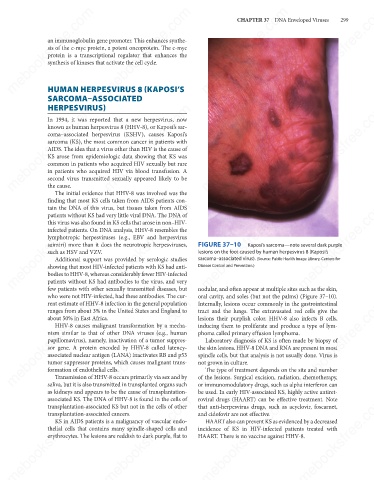
 mebooksfree.com  mebooksfree.com           mebooksfree.com              FIGURE 37–10    Kaposi’s sarcoma—note several dark purple         mebooksfree.com
                                                                                                            mebooksfree.com
                                                                            mebooksfree.com
                        tain the DNA of this virus, but tissues taken from AIDS
                        patients without KS had very little viral DNA. The DNA of
                        this virus was also found in KS cells that arose in non–HIV-
                        infected patients. On DNA analysis, HHV-8 resembles the
                        lymphotropic herpesviruses (e.g., EBV and herpesvirus
                        saimiri) more than it does the neurotropic herpesviruses,
                        such as HSV and VZV.
                                                                         lesions on the foot caused by human herpesvirus 8 (Kaposi’s
                          Additional support was provided by serologic studies
                                                                         sarcoma–associated virus). (Source: Public Health Image Library, Centers for
                        showing that most HIV-infected patients with KS had anti-
                                                                         Disease Control and Prevention.)
                        bodies to HHV-8, whereas considerably fewer HIV-infected
                        patients without KS had antibodies to the virus, and very
                        few patients with other sexually transmitted diseases, but
                        who were not HIV-infected, had these antibodies. The cur-  nodular, and often appear at multiple sites such as the skin,
                                                                         oral cavity, and soles (but not the palms) (Figure 37–10).
 mebooksfree.com  mebooksfree.com           mebooksfree.com              inducing them to proliferate and produce a type of lym-           mebooksfree.com
                                                                                                            mebooksfree.com
                                                                            mebooksfree.com
                        rent estimate of HHV-8 infection in the general population
                                                                         Internally, lesions occur commonly in the gastrointestinal
                        ranges from about 3% in the United States and England to
                                                                         tract and the lungs. The extravasated red cells give the
                        about 50% in East Africa.
                                                                         lesions their purplish color. HHV-8 also infects B cells,
                          HHV-8 causes malignant transformation by a mecha-
                        nism similar to that of other DNA viruses (e.g., human
                                                                         phoma called primary effusion lymphoma.
                        papillomavirus), namely, inactivation of a tumor suppres-
                                                                           Laboratory diagnosis of KS is often made by biopsy of
                        sor gene. A protein encoded by HHV-8 called latency-
                                                                         the skin lesions. HHV-8 DNA and RNA are present in most
                        associated nuclear antigen (LANA) inactivates RB and p53
                                                                         spindle cells, but that analysis is not usually done. Virus is
                        tumor suppressor proteins, which causes malignant trans-
                                                                         not grown in culture.
                        formation of endothelial cells.
                                                                           The type of treatment depends on the site and number
                          Transmission of HHV-8 occurs primarily via sex and by
                        saliva, but it is also transmitted in transplanted organs such
                                                                         or immunomodulatory drugs, such as alpha interferon can
                        as kidneys and appears to be the cause of transplantation-  of the lesions. Surgical excision, radiation, chemotherapy,
                                                                         be used. In early HIV-associated KS, highly active antiret-
                        associated KS. The DNA of HHV-8 is found in the cells of
                                                                            mebooksfree.com
 mebooksfree.com  mebooksfree.com           mebooksfree.com              incidence of KS in HIV-infected patients treated with             mebooksfree.com
                                                                                                            mebooksfree.com
                                                                         roviral drugs (HAART) can be effective treatment. Note
                        transplantation-associated KS but not in the cells of other
                                                                         that anti-herpesvirus drugs, such as acyclovir, foscarnet,
                        transplantation-associated cancers.
                                                                         and cidofovir are not effective.
                          KS in AIDS patients is a malignancy of vascular endo-
                                                                           HAART also can prevent KS as evidenced by a decreased
                        thelial  cells  that  contains  many  spindle-shaped  cells  and
                        erythrocytes. The lesions are reddish to dark purple, flat to
                                                                         HAART. There is no vaccine against HHV-8.
 mebooksfree.com  mebooksfree.com           mebooksfree.com                 mebooksfree.com                 mebooksfree.com                mebooksfree.com

