


Page 305 - Review of Medical Microbiology and Immunology ( PDFDrive )
P. 305
mebooksfree.com


                                                                            mebooksfree.com
                                                                                                                                           mebooksfree.com
            mebooksfree.com
                                                                                                            mebooksfree.com
 mebooksfree.com  mebooksfree.com           mebooksfree.com                 mebooksfree.com                 mebooksfree.com                mebooksfree.com
                                            mebooksfree.com
                       PART IV  Clinical Virology
                 294
                    Pathogenesis & Immunity
                    VZV infects the mucosa of the upper respiratory tract, and
                    then spreads via the blood to the skin, where the typical
                    vesicular  rash occurs.  Multinucleated  giant  cells with
                    intranuclear inclusions are seen in the base of the lesions.
                    The virus infects sensory neurons and is carried by retro-
                    grade axonal flow into the cells of the dorsal root ganglia,
                    where the virus becomes latent.
                       In latently infected cells, VZV DNA is located in the
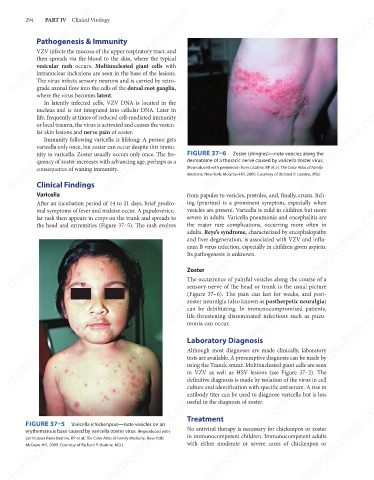
 mebooksfree.com  mebooksfree.com           mebooksfree.com          FIGURE 37–6    Zoster (shingles)—note vesicles along the              mebooksfree.com
                                                                            mebooksfree.com
                                                                                                            mebooksfree.com
                    nucleus and is not integrated into cellular DNA. Later in
                    life, frequently at times of reduced cell-mediated immunity
                    or local trauma, the virus is activated and causes the vesicu-
                    lar skin lesions and nerve pain of zoster.
                       Immunity following varicella is lifelong: A person gets
                    varicella only once, but zoster can occur despite this immu-
                    nity to varicella. Zoster usually occurs only once. The fre-
                                                                     dermatome of a thoracic nerve caused by varicella-zoster virus.
                    quency of zoster increases with advancing age, perhaps as a
                                                                     (Reproduced with permission from Usatine, RP et al: The Color Atlas of Family
                    consequence of waning immunity.
                    Clinical Findings
                    Varicella                                        Medicine, New York: McGraw-Hill, 2009. Courtesy of Richard P. Usatine, MD.)
                                                                     from papules to vesicles, pustules, and, finally, crusts. Itch-
                                                                     ing (pruritus) is a prominent symptom, especially when
                    After an incubation period of 14 to 21 days, brief prodro-
 mebooksfree.com  mebooksfree.com           mebooksfree.com          the major rare complications, occurring more often in                 mebooksfree.com
                                                                                                            mebooksfree.com
                                                                            mebooksfree.com
                                                                     vesicles are present. Varicella is mild in children but more
                    mal symptoms of fever and malaise occur. A papulovesicu-
                                                                     severe in adults. Varicella pneumonia and encephalitis are
                    lar rash then appears in crops on the trunk and spreads to
                    the head and extremities (Figure 37–5). The rash evolves
                                                                     adults. Reye’s syndrome, characterized by encephalopathy
                                                                     and liver degeneration, is associated with VZV and influ-
                                                                     enza B virus infection, especially in children given aspirin.
                                                                     Its pathogenesis is unknown.
                                                                           Zoster
                                                                     The occurrence of painful vesicles along the course of a
                                                                     sensory nerve of the head or trunk is the usual picture
                                                                     (Figure 37–6). The pain can last for weeks, and post-
                                                                            mebooksfree.com
                                                                     zoster neuralgia (also known as postherpetic neuralgia)
 mebooksfree.com  mebooksfree.com           mebooksfree.com          monia can occur.                       mebooksfree.com                mebooksfree.com
                                                                     can  be  debilitating.  In  immunocompromised  patients,
                                                                     life-threatening disseminated infections such as pneu-


                                                                     Laboratory Diagnosis
                                                                     Although most diagnoses are made clinically, laboratory
                                                                     tests are available. A presumptive diagnosis can be made by
                                                                     using the Tzanck smear. Multinucleated giant cells are seen
                                                                     in  VZV as  well  as HSV lesions (see Figure 37–2). The
                                                                     definitive diagnosis is made by isolation of the virus in cell
                                                                     culture and identification with specific antiserum. A rise in
                                                                     antibody titer can be used to diagnose varicella but is less
 mebooksfree.com  mebooksfree.com           mebooksfree.com          Treatment                              mebooksfree.com                mebooksfree.com
                                                                            mebooksfree.com
                                                                     useful in the diagnosis of zoster.

                 FIGURE 37–5
                                Varicella (chickenpox)—note vesicles on an
                                                                     No antiviral therapy is necessary for chickenpox or zoster
                 erythematous base caused by varicella-zoster virus. (Reproduced with
                                                                     in immunocompetent children. Immunocompetent adults
                 permission from Usatine, RP et al: The Color Atlas of Family Medicine, New York:
                                                                     with either moderate or severe cases of chickenpox or
                 McGraw-Hill, 2009. Courtesy of Richard P. Usatine, MD.)


 mebooksfree.com  mebooksfree.com           mebooksfree.com                 mebooksfree.com                 mebooksfree.com                mebooksfree.com

