


Page 330 - Review of Medical Microbiology and Immunology ( PDFDrive )
P. 330
mebooksfree.com
                                                                            mebooksfree.com
 mebooksfree.com

                                            mebooksfree.com
            mebooksfree.com
                                                                                                                                           mebooksfree.com
 mebooksfree.com  mebooksfree.com           mebooksfree.com              the surface of human macrophages, the production of   319         mebooksfree.com
                                                                                                            mebooksfree.com
                                                                            mebooksfree.com
                                                                                      CHAPTER 39  RNA Enveloped Viruses
                        Transmission & Epidemiology
                                                                         interleukin-12 (IL-12), which is necessary for cell-mediated
                        Measles virus is transmitted via respiratory droplets pro-
                                                                         immunity to occur, is suppressed.
                        duced by coughing and sneezing both during the prodro-
                        mal period and for a few days after the rash appears.
                                                                         Clinical Findings
                        Measles occurs worldwide, usually in outbreaks every 2 to
                        3 years, when the number of susceptible children reaches a
                                                                         phase characterized by fever, conjunctivitis (causing photo-
                        high level. The WHO estimates there are 30 million cases
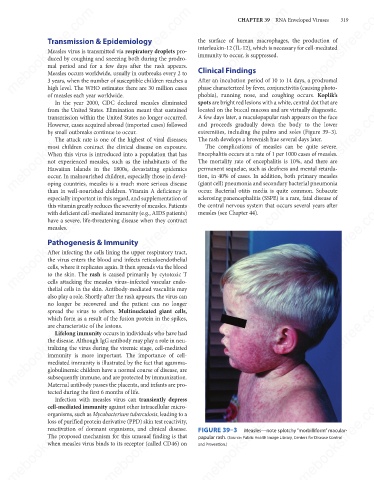
                                                                         phobia), running nose, and coughing occurs.  Koplik’s
                        of measles each year worldwide.
                                                                         spots are bright red lesions with a white, central dot that are
                          In the year 2000, CDC declared measles eliminated   After an incubation period of 10 to 14 days, a prodromal
 mebooksfree.com  mebooksfree.com           mebooksfree.com              extremities, including the palms and soles (Figure 39–3).         mebooksfree.com
                                                                            mebooksfree.com
                                                                                                            mebooksfree.com
                                                                         located on the buccal mucosa and are virtually diagnostic.
                        from the United States. Elimination meant that sustained
                                                                         A few days later, a maculopapular rash appears on the face
                        transmission within the United States no longer occurred.
                                                                         and proceeds gradually down the body to the lower
                        However, cases acquired abroad (imported cases) followed
                        by small outbreaks continue to occur.
                                                                         The rash develops a brownish hue several days later.
                          The attack rate is one of the highest of viral diseases;
                                                                           The complications of measles can be quite severe.
                        most children contract the clinical disease on exposure.
                                                                         Encephalitis occurs at a rate of 1 per 1000 cases of measles.
                        When this virus is introduced into a population that has
                                                                         The mortality rate of encephalitis is 10%, and there are
                        not experienced measles, such as the inhabitants of the
                                                                         permanent sequelae, such as deafness and mental retarda-
                        Hawaiian Islands in the 1800s, devastating epidemics
                        occur. In malnourished children, especially those in devel-
                                                                         (giant cell) pneumonia and secondary bacterial pneumonia
                        oping countries, measles is a much more serious disease
                                                                         occur. Bacterial  otitis  media is quite  common.  Subacute
                        than in well-nourished children. Vitamin A deficiency is
                                                                         sclerosing panencephalitis (SSPE) is a rare, fatal disease of
                        especially important in this regard, and supplementation of   tion, in 40% of cases. In addition, both primary measles
 mebooksfree.com  mebooksfree.com           mebooksfree.com                 mebooksfree.com                 mebooksfree.com                mebooksfree.com
                                                                         the central nervous system that occurs several years after
                        this vitamin greatly reduces the severity of measles. Patients
                                                                         measles (see Chapter 44).
                        with deficient cell-mediated immunity (e.g., AIDS patients)
                        have a severe, life-threatening disease when they contract
                        measles.
                        Pathogenesis & Immunity
                        After infecting the cells lining the upper respiratory tract,
                        the virus enters the blood and infects reticuloendothelial
                        cells, where it replicates again. It then spreads via the blood
                        to the skin. The  rash is caused primarily by cytotoxic T
                        cells attacking the measles virus–infected vascular endo-
                        thelial cells in the skin. Antibody-mediated vasculitis may
                        also play a role. Shortly after the rash appears, the virus can
 mebooksfree.com  mebooksfree.com           mebooksfree.com                 mebooksfree.com                 mebooksfree.com                mebooksfree.com
                        no longer be recovered and the patient can no longer
                        spread the virus to others.  Multinucleated giant cells,
                        which form as a result of the fusion protein in the spikes,
                        are characteristic of the lesions.
                          Lifelong immunity occurs in individuals who have had
                        the disease. Although IgG antibody may play a role in neu-
                        tralizing the virus during the viremic stage, cell-mediated
                        immunity  is  more  important.  The  importance  of  cell-
                        mediated immunity is illustrated by the fact that agamma-
                        globulinemic children have a normal course of disease, are
                        subsequently immune, and are protected by immunization.
                        Maternal antibody passes the placenta, and infants are pro-
                        tected during the first 6 months of life.
                                                                            mebooksfree.com
                                                                                                            mebooksfree.com
 mebooksfree.com  mebooksfree.com           mebooksfree.com              FIGURE 39–3    Measles—note splotchy “morbilliform” macular-      mebooksfree.com
                          Infection with measles virus can  transiently depress
                        cell-mediated immunity against other intracellular micro-
                        organisms, such as Mycobacterium tuberculosis, leading to a
                        loss of purified protein derivative (PPD) skin test reactivity,
                        reactivation of dormant organisms, and clinical disease.
                        The proposed mechanism for this unusual finding is that
                                                                         papular rash. (Source: Public Health Image Library, Centers for Disease Control
                        when measles virus binds to its receptor (called CD46) on
                                                                         and Prevention.)


 mebooksfree.com  mebooksfree.com           mebooksfree.com                 mebooksfree.com                 mebooksfree.com                mebooksfree.com

