


Page 332 - Review of Medical Microbiology and Immunology ( PDFDrive )
P. 332
mebooksfree.com
                                                                            mebooksfree.com
 mebooksfree.com

            mebooksfree.com
                                                                            mebooksfree.com
                                            mebooksfree.com
 mebooksfree.com  mebooksfree.com           mebooksfree.com              Prevention   CHAPTER 39  RNA Enveloped Viruses  321               mebooksfree.com
                                                                                                                                           mebooksfree.com
                                                                                                            mebooksfree.com

                                                                         Prevention consists of immunization with the live, attenu-
                                                                         ated vaccine. The vaccine is effective and long-lasting (at
                                                                         least 10 years) and causes few side effects. Two immuniza-
                                                                         tions are recommended, one at 15 months and a booster
                                                                         dose at 4 to 6 years, usually in combination with measles
                                                                         and rubella vaccines. Because it is a live vaccine, it should
                                                                         not be given to immunocompromised persons or pregnant
                                                                         women. Immune globulin is not useful for preventing or
                                                                            mebooksfree.com
                                                                                                            mebooksfree.com
 mebooksfree.com  mebooksfree.com           mebooksfree.com              the recommendation in 1989 that a second course of the            mebooksfree.com
                                                                         mitigating mumps orchitis.
                                                                           In the late 1980s, outbreaks of mumps occurred in
                                                                         both immunized and unimmunized people. This led to
                                                                         MMR (measles, mumps, rubella) vaccine be adminis-
                                                                         tered. The incidence of mumps fell, and outbreaks did not
                                                                         occur until 2006, when 6584 cases occurred, primarily in
                                                                         college-age  individuals  who,  surprisingly,  had  received
                                                                         two doses of the vaccine. Waning immunity after the sec-
                                                                         ond dose and immunization with a different genotype
                                                                         from the genotype that caused the outbreak are suggested
                                                                         explanations.
                                                                           In 2009 and again in 2014, outbreaks of mumps occurred
                                                                            mebooksfree.com
 mebooksfree.com  mebooksfree.com           mebooksfree.com              that waning immunity may play a role. mebooksfree.com             mebooksfree.com
                                                                         in young adults including those who had received two
                                                                         doses of vaccine. In many individuals, more than 10 years
                                                                         had elapsed since their last MMR immunization, indicating
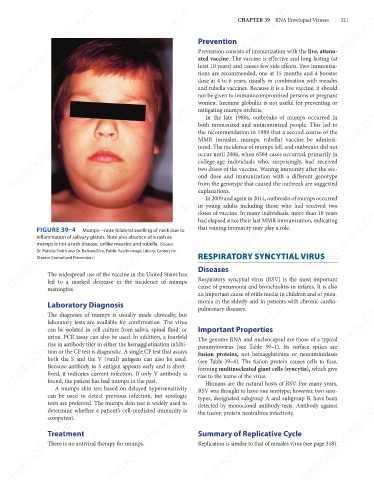
                    FIGURE 39–4
                                   Mumps—note bilateral swelling of neck due to
                    inflammation of salivary glands. Note also absence of a rash as
                    mumps is not a rash disease, unlike measles and rubella. (Source:
                    Dr. Patricia Smith and Dr. Barbara Rice, Public Health Image Library, Centers for
                                                                         RESPIRATORY SYNCYTIAL VIRUS
                    Disease Control and Prevention.)
                                                                         Diseases
                        The widespread use of the vaccine in the United States has
                                                                         Respiratory syncytial virus (RSV) is the most important
                        led to a marked decrease in the incidence of mumps
                                                                         cause of pneumonia and bronchiolitis in infants. It is also
                        meningitis.
                                                                         an important cause of otitis media in children and of pneu-
                                                                            mebooksfree.com
 mebooksfree.com  mebooksfree.com           mebooksfree.com              Important Properties               mebooksfree.com                mebooksfree.com
                                                                         monia in the elderly and in patients with chronic cardio-
                        Laboratory Diagnosis
                                                                         pulmonary diseases.
                        The diagnosis of mumps is usually made clinically, but
                        laboratory tests are available for confirmation. The virus
                        can be isolated in cell culture from saliva, spinal fluid, or
                        urine. PCR assay can also be used. In addition, a fourfold
                                                                         The genome RNA and nucleocapsid are those of a typical
                        rise in antibody titer in either the hemagglutination inhibi-
                                                                         paramyxovirus  (see  Table  39–1).  Its  surface  spikes  are
                        tion or the CF test is diagnostic. A single CF test that assays
                                                                         fusion proteins,  not hemagglutinins  or neuraminidases
                        both the S and the V (viral) antigens can also be used.
                                                                         (see Table 39–4). The fusion protein causes cells to fuse,
                        Because antibody to S antigen appears early and is short-
                                                                         forming multinucleated giant cells (syncytia), which give
                        lived, it indicates current infection. If only V antibody is
                                                                         rise to the name of the virus.
                        found, the patient has had mumps in the past.
                                                                           Humans are the natural hosts of RSV. For many years,
                          A mumps skin test based on delayed hypersensitivity
                                                                         RSV was thought to have one serotype; however, two sero-
                        can be used to detect previous infection, but serologic
 mebooksfree.com  mebooksfree.com           mebooksfree.com              types, designated subgroup A and subgroup B, have been            mebooksfree.com
                                                                                                            mebooksfree.com
                                                                            mebooksfree.com
                        tests are preferred. The mumps skin test is widely used to
                                                                         detected by monoclonal antibody tests. Antibody against
                        determine whether a patient’s cell-mediated immunity is
                                                                         the fusion protein neutralizes infectivity.
                        competent.
                        Treatment
                                                                         Summary of Replicative Cycle
                                                                         Replication is similar to that of measles virus (see page 318).
                        There is no antiviral therapy for mumps.

 mebooksfree.com  mebooksfree.com           mebooksfree.com                 mebooksfree.com                 mebooksfree.com                mebooksfree.com

