


Page 344 - Review of Medical Microbiology and Immunology ( PDFDrive )
P. 344
mebooksfree.com
 mebooksfree.com


                                                                                                                                           mebooksfree.com
            mebooksfree.com
                                            mebooksfree.com
 mebooksfree.com  mebooksfree.com           mebooksfree.com                 mebooksfree.com         C   H  A   P  T   E  R                 mebooksfree.com
                                                                            mebooksfree.com
                                                                                                            mebooksfree.com
                    RNA Nonenveloped Viruses 40


 mebooksfree.com  mebooksfree.com           mebooksfree.com              REOVIRUSES                         mebooksfree.com                mebooksfree.com
                                                                            mebooksfree.com


                       CHAPTER  C ONTENT S


                       PICORNAVIRUSES
                       Enteroviruses
                                                                         Rotavirus
                       Rhinoviruses
                                                                         Self-Assessment Questions
                                                                         Summaries of Organisms
                       CALICIVIRUSES
                       Norovirus
                                                                         Practice Questions: USMLE & Course Examinations
                                                                            mebooksfree.com
 mebooksfree.com  mebooksfree.com           mebooksfree.com              rhinoviruses grow better at 33°C, in accordance with the          mebooksfree.com
                                                                                                            mebooksfree.com

                        PICORNAVIRUSES


                                                                           Enteroviruses  replicate  optimally  at  37°C,  whereas
                        Picornaviruses are small (20–30 nm) nonenveloped viruses
                        composed of an icosahedral nucleocapsid and a single-
                                                                         lower temperature of the nose. Enteroviruses are stable
                        stranded RNA genome. The genome RNA has positive
                        polarity (i.e., on entering the cell, it functions as the viral
                                                                         under  acid conditions  (pH 3–5), which  enables  them  to
                        mRNA). There is no polymerase within the virion. Picor-
                                                                         acid-labile. This explains why rhinovirus infections are
                        naviruses replicate in the cytoplasm of cells. They are not
                                                                         restricted to the nose and throat.
                        inactivated by lipid solvents, such as ether, because they do
                                                                           Important features of viruses that commonly infect the
                        not have an envelope.                            survive exposure to gastric acid, whereas rhinoviruses are
 mebooksfree.com  mebooksfree.com           mebooksfree.com              which is described in Chapter 38.  mebooksfree.com                mebooksfree.com
                                                                            mebooksfree.com
                                                                         intestinal tract are summarized in Table 40–2. These
                          The picornavirus family includes two groups of medical
                                                                         include the picornaviruses but also rotavirus and norovirus,
                        importance:  the  enteroviruses  and  the  rhinoviruses.
                                                                         which are described later in this chapter, and adenovirus,
                        Among the major enteroviruses are poliovirus, Coxsackie
                        viruses, echoviruses, and hepatitis A virus (which is
                        described in Chapter 41). Enteroviruses  infect primarily
                        the enteric tract, whereas rhinoviruses are found in the
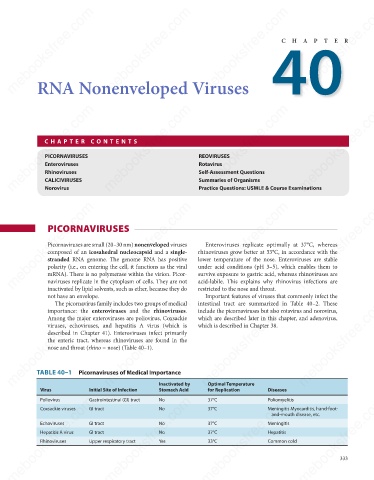
                        nose and throat (rhino = nose) (Table 40–1).
                    TABLE 40–1  Picornaviruses of Medical Importance

                                                            Stomach Acid
                     Virus           Initial Site of Infection  Inactivated by   Optimal Temperature   Diseases
                                                                            for Replication
 mebooksfree.com  mebooksfree.com    GI tract mebooksfree.com               mebooksfree.com                 mebooksfree.com                mebooksfree.com
                     Poliovirus
                                                                            37°C
                                                                                                Poliomyelitis
                                                            No
                                     Gastrointestinal (GI) tract
                                     GI tract
                                                                                                Meningitis Myocarditis, hand-foot-
                                                                            37°C
                     Coxsackie viruses
                                                            No
                                                                                                 and-mouth disease, etc.
                                                                            37°C
                                                                                                Meningitis
                                                            No
                     Echoviruses
                                                            No
                                                                                                Hepatitis
                                                                            37°C
                     Hepatitis A virus
                                     GI tract
                                                                                                Common cold
                                     Upper respiratory tract
                     Rhinoviruses
                                                                            33°C
                                                            Yes
                                                                                                                       333
 mebooksfree.com  mebooksfree.com           mebooksfree.com                 mebooksfree.com                 mebooksfree.com                mebooksfree.com

