


Page 345 - Review of Medical Microbiology and Immunology ( PDFDrive )
P. 345
mebooksfree.com
mebooksfree.com
mebooksfree.com
mebooksfree.com
mebooksfree.com
mebooksfree.com
mebooksfree.com mebooksfree.com mebooksfree.com mebooksfree.com Vaccine mebooksfree.com mebooksfree.com
PART IV Clinical Virology
334
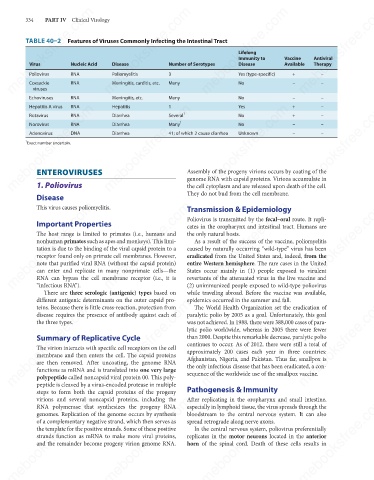
TABLE 40–2 Features of Viruses Commonly Infecting the Intestinal Tract
Lifelong
Immunity to
Antiviral
Disease
Disease
Available
Nucleic Acid
Therapy
Number of Serotypes
Virus
3
Yes (type-specific)
Poliovirus
–
RNA
Poliomyelitis
+
Coxsackie
viruses
No
Echoviruses RNA Meningitis, carditis, etc. Many 1 1 No + – – – – – –
RNA
Meningitis, etc.
Many
mebooksfree.com
mebooksfree.com mebooksfree.com mebooksfree.com Assembly of the progeny virions occurs by coating of the mebooksfree.com
mebooksfree.com
1
Hepatitis
Yes
RNA
Hepatitis A virus
+
Rotavirus
RNA
No
Diarrhea
Several
Norovirus
No
Many
–
–
Diarrhea
RNA
41; of which 2 cause diarrhea
Diarrhea
DNA
Unknown
–
–
Adenovirus
1
Exact number uncertain.
ENTEROVIRUSES
1. Poliovirus
the cell cytoplasm and are released upon death of the cell.
They do not bud from the cell membrane.
Disease genome RNA with capsid proteins. Virions accumulate in
mebooksfree.com mebooksfree.com mebooksfree.com cates in the oropharynx and intestinal tract. Humans are mebooksfree.com
mebooksfree.com
mebooksfree.com
This virus causes poliomyelitis.
Transmission & Epidemiology
Poliovirus is transmitted by the fecal–oral route. It repli-
Important Properties
The host range is limited to primates (i.e., humans and
the only natural hosts.
nonhuman primates such as apes and monkeys). This limi-
As a result of the success of the vaccine, poliomyelitis
tation is due to the binding of the viral capsid protein to a
caused by naturally occurring “wild-type” virus has been
eradicated from the United States and, indeed, from the
receptor found only on primate cell membranes. However,
note that purified viral RNA (without the capsid protein)
entire Western hemisphere. The rare cases in the United
can enter and replicate in many nonprimate cells—the
RNA can bypass the cell membrane receptor (i.e., it is
revertants of the attenuated virus in the live vaccine and
“infectious RNA”).
(2) unimmunized people exposed to wild-type poliovirus
There are three serologic (antigenic) types based on States occur mainly in (1) people exposed to virulent
while traveling abroad. Before the vaccine was available,
different antigenic determinants on the outer capsid pro-
epidemics occurred in the summer and fall.
mebooksfree.com
mebooksfree.com mebooksfree.com mebooksfree.com was not achieved. In 1988, there were 388,000 cases of para- mebooksfree.com
mebooksfree.com
The World Health Organization set the eradication of
teins. Because there is little cross-reaction, protection from
disease requires the presence of antibody against each of
paralytic polio by 2005 as a goal. Unfortunately, this goal
the three types.
lytic polio worldwide, whereas in 2005 there were fewer
Summary of Replicative Cycle
than 2000. Despite this remarkable decrease, paralytic polio
continues to occur. As of 2012, there were still a total of
The virion interacts with specific cell receptors on the cell
approximately 200 cases each year in three countries:
membrane and then enters the cell. The capsid proteins
Afghanistan, Nigeria, and Pakistan. Thus far, smallpox is
are then removed. After uncoating, the genome RNA
the only infectious disease that has been eradicated, a con-
functions as mRNA and is translated into one very large
polypeptide called noncapsid viral protein 00. This poly-
peptide is cleaved by a virus-encoded protease in multiple
Pathogenesis & Immunity
steps to form both the capsid proteins of the progeny sequence of the worldwide use of the smallpox vaccine.
mebooksfree.com mebooksfree.com mebooksfree.com spread retrograde along nerve axons. mebooksfree.com mebooksfree.com
mebooksfree.com
virions and several noncapsid proteins, including the
After replicating in the oropharynx and small intestine,
RNA polymerase that synthesizes the progeny RNA
especially in lymphoid tissue, the virus spreads through the
bloodstream to the central nervous system. It can also
genomes. Replication of the genome occurs by synthesis
of a complementary negative strand, which then serves as
the template for the positive strands. Some of these positive
In the central nervous system, poliovirus preferentially
strands function as mRNA to make more viral proteins,
replicates in the motor neurons located in the anterior
and the remainder become progeny virion genome RNA.
horn of the spinal cord. Death of these cells results in
mebooksfree.com mebooksfree.com mebooksfree.com mebooksfree.com mebooksfree.com mebooksfree.com

