


Page 366 - Review of Medical Microbiology and Immunology ( PDFDrive )
P. 366
mebooksfree.com
                                                                            mebooksfree.com
 mebooksfree.com

            mebooksfree.com
                                                                                                            mebooksfree.com
                                                                                                                                           mebooksfree.com
 mebooksfree.com  mebooksfree.com       1   mebooksfree.com              blood ingested during an insect bite. After ingestion, the   355  mebooksfree.com
                                            mebooksfree.com
                                                                            mebooksfree.com
                                                                                               CHAPTER 42  Arboviruses
                    TABLE 42–1  Classification of Major Arboviruses
                                                                         virus replicates in the gut of the arthropod and then
                                             Viruses of Medical Interest
                                                                         spreads to other organs, including the salivary glands.
                                 Genus
                     Family
                                             in the Americas
                                                                         Only the female of the species serves as the vector of the
                     Togavirus
                                             Eastern equine encephalitis virus,
                                 Alphavirus
                                                                         virus, because only she requires a blood meal in order for
                                              western equine encephalitis
                                              virus, chikungunya virus
                                                                                                        5
                                                                         called the extrinsic incubation period,  must pass before
                                       2
                                 Flavivirus
                     Flavivirus
                                             St. Louis encephalitis virus, yellow
                                                                         the virus has replicated sufficiently for the saliva of the
                                              fever virus, dengue virus, West
                                                                         vector to contain enough virus to transmit an infectious
                                              Nile virus                 progeny to be produced. An obligatory length of time,
                                                                         dose. For most viruses, the extrinsic incubation period
 mebooksfree.com  mebooksfree.com           mebooksfree.com              arboviruses are transmitted by vertical “transovarian” pas-       mebooksfree.com
                                                                            mebooksfree.com
                                                                                                            mebooksfree.com
                                        3
                                             California encephalitis virus
                     Bunyavirus
                                 Bunyavirus
                                                                         ranges from 7 to 14 days.
                     Reovirus
                                             Colorado tick fever virus
                                 Orbivirus
                                                                           In addition to transmission through vertebrates, some
                    1
                     Alphaviruses of other regions include Chikungunya, Mayaro, O’Nyong-Nyong, Ross
                    River, and Semliki Forest viruses.
                                                                         sage from the mother tick to her offspring. Vertical trans-
                    2
                     Flaviviruses of other regions include Japanese encephalitis, Kyasanur Forest, Murray
                                                                         mission has important survival value for the virus if a
                    Valley encephalitis, Omsk hemorrhagic fever, Powassan encephalitis viruses, and
                                                                         vertebrate host is unavailable.
                    West Nile viruses.
                                                                           Humans are involved in the transmission cycle of arbo-
                    3
                     Bunyaviruses of other regions include the Bunyamwera complex of viruses and
                    Oropouche virus.
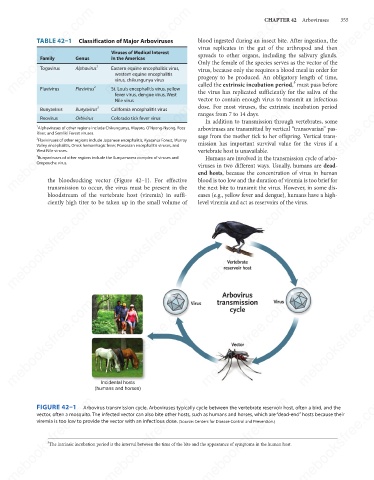
                                                                         viruses in two different ways. Usually, humans are dead-
                                                                         blood is too low and the duration of viremia is too brief for
                        the bloodsucking vector (Figure 42–1). For effective
                        transmission  to  occur,  the  virus  must  be  present  in  the
                                                                         the next bite to transmit the virus. However, in some dis-
                                                                         eases (e.g., yellow fever and dengue), humans have a high-
                        bloodstream of the vertebrate host (viremia) in suffi-  end hosts, because the concentration of virus in human
                                                                         level viremia and act as reservoirs of the virus.
                        ciently high titer to be taken up in the small volume of
 mebooksfree.com  mebooksfree.com           mebooksfree.com                 mebooksfree.com                 mebooksfree.com                mebooksfree.com
 mebooksfree.com  mebooksfree.com           mebooksfree.com                 mebooksfree.com                 mebooksfree.com                mebooksfree.com


                                         Incidental hosts
                                       (humans and horses)
 mebooksfree.com  mebooksfree.com           mebooksfree.com                 mebooksfree.com                 mebooksfree.com                mebooksfree.com
                    FIGURE 42–1
                                   Arbovirus transmission cycle. Arboviruses typically cycle between the vertebrate reservoir host, often a bird, and the
                    vector, often a mosquito. The infected vector can also bite other hosts, such as humans and horses, which are “dead-end” hosts because their
                    viremia is too low to provide the vector with an infectious dose. (Source: Centers for Disease Control and Prevention.)


                        5
                        The intrinsic incubation period is the interval between the time of the bite and the appearance of symptoms in the human host.


 mebooksfree.com  mebooksfree.com           mebooksfree.com                 mebooksfree.com                 mebooksfree.com                mebooksfree.com

