


Page 367 - Review of Medical Microbiology and Immunology ( PDFDrive )
P. 367
mebooksfree.com
mebooksfree.com
mebooksfree.com
mebooksfree.com
mebooksfree.com
mebooksfree.com
mebooksfree.com
mebooksfree.com mebooksfree.com mebooksfree.com severe disease and is associated with the highest fatality mebooksfree.com
mebooksfree.com
PART IV Clinical Virology
356
Infection by arboviruses usually does not result in dis-
ease either in the arthropod vector or in the vertebrate
rate (approximately 50%). In its natural habitat, the virus
animal that serves as the natural host. Disease occurs pri-
is transmitted primarily by the swamp mosquito, Culi-
marily when the virus infects dead-end hosts. For example,
seta, among the small wild birds of the Atlantic and Gulf
yellow fever virus cycles harmlessly among the jungle mon-
Coast states. Species of Aedes mosquitoes are suspected of
keys in South America, but when the virus infects a human,
principal dead-end hosts, horses, and humans. The
yellow fever can occur.
number of cases of human encephalitis caused by EEE
Clinical Findings & Epidemiology carrying the virus from its wild bird reservoir to the
virus in the United States usually ranges from zero to four
per year, but outbreaks involving hundreds of cases also
mebooksfree.com
mebooksfree.com
mebooksfree.com mebooksfree.com mebooksfree.com severe headache, nausea, vomiting, and fever. Changes in mebooksfree.com
Most human arboviral infections are asymptomatic. Of
occur. Subclinical infections greatly exceed the number of
those infections that are symptomatic, most are acute
overt cases.
febrile illnesses. A minority of infections cause neuroinva-
The encephalitis is characterized by the sudden onset of
sive disease, such as encephalitis and meningitis. The dis-
eases caused by arboviruses range in severity from mild to
mental status, such as confusion and stupor, ensue. A rap-
rapidly fatal.
idly progressive downhill course with nuchal rigidity, sei-
The clinical picture usually fits one of three categories:
zures, and coma occurs. If the patient survives, the central
(1) encephalitis; (2) hemorrhagic fever; or (3) fever with
nervous system sequelae are usually severe. Immunity fol-
myalgias, arthralgias, and nonhemorrhagic rash. The
lowing the infection is lifelong.
pathogenesis of these diseases involves not only the cytoci-
The diagnosis is made by either isolating the virus or
dal effect of the virus, but also, in some, a prominent
immunopathologic component. After recovery from the
have a high index of suspicion in the summer months in
disease, immunity is usually lifelong. demonstrating a rise in antibody titer. Clinicians should
the appropriate geographic areas. The disease does not
mebooksfree.com
mebooksfree.com mebooksfree.com mebooksfree.com mosquitoes, or perhaps some other animal. mebooksfree.com mebooksfree.com
The arboviral diseases occur primarily in the tropics but
occur in the winter because mosquitoes are not active. It is
are also found in temperate zones such as the United States
not known how the virus survives the winter—in birds,
and as far north as Alaska and Siberia. They have a tendency
to cause sudden outbreaks of disease, generally at the inter-
No antiviral therapy is available. A killed vaccine is
face between human communities and jungle or forest areas.
available to protect horses but not humans. The disease is
too rare for production of a human vaccine to be economi-
IMPORTANT ARBOVIRUSES
cally feasible.
THAT CAUSE DISEASE IN THE
Western Equine Encephalitis Virus
UNITED STATES
Eastern Equine Encephalitis Virus
more frequently than does EEE virus, but the illness is less
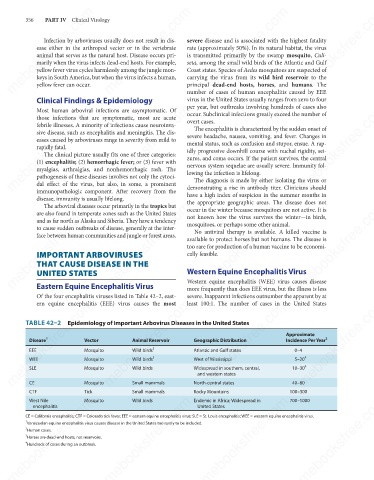
Of the four encephalitis viruses listed in Table 42–2, east- Western equine encephalitis (WEE) virus causes disease
severe. Inapparent infections outnumber the apparent by at
mebooksfree.com mebooksfree.com mebooksfree.com Geographic Distribution Approximate 2 mebooksfree.com
mebooksfree.com
mebooksfree.com
ern equine encephalitis (EEE) virus causes the most
least 100:1. The number of cases in the United States
TABLE 42–2 Epidemiology of Important Arbovirus Diseases in the United States
1
Disease
Incidence Per Year
Vector
Animal Reservoir
3
0–4
Atlantic and Gulf states
Mosquito
EEE
Wild birds
4
3
Wild birds
West of Mississippi
5–20
WEE
Mosquito
4
SLE
and western states
North-central states
40–80
Small mammals
Mosquito
CE
Tick
Rocky Mountains
CTF Mosquito Wild birds Widespread in southern, central, 10–30
Small mammals
100–300
mebooksfree.com mebooksfree.com mebooksfree.com mebooksfree.com mebooksfree.com mebooksfree.com
Wild birds
700–1000
Mosquito
Endemic in Africa; Widespread in
West Nile
encephalitis
United States
CE = California encephalitis; CTF = Colorado tick fever; EEE = eastern equine encephalitis virus; SLE = St. Louis encephalitis; WEE = western equine encephalitis virus.
1
Venezuelan equine encephalitis virus causes disease in the United States too rarely to be included.
2
Human cases.
3
Horses are dead-end hosts, not reservoirs.
4
Hundreds of cases during an outbreak.
mebooksfree.com mebooksfree.com mebooksfree.com mebooksfree.com mebooksfree.com mebooksfree.com

