


Page 455 - Review of Medical Microbiology and Immunology ( PDFDrive )
P. 455
mebooksfree.com


                                                                            mebooksfree.com
                                                                                                                                           mebooksfree.com
            mebooksfree.com
                                            mebooksfree.com
 mebooksfree.com  mebooksfree.com           mebooksfree.com                 mebooksfree.com                 mebooksfree.com                mebooksfree.com
                                                                                                            mebooksfree.com
                       PART VI  Parasitology
                 444


 mebooksfree.com  mebooksfree.com           mebooksfree.com                 mebooksfree.com                 mebooksfree.com                mebooksfree.com


 mebooksfree.com  mebooksfree.com           mebooksfree.com                 mebooksfree.com                 mebooksfree.com                mebooksfree.com


 mebooksfree.com  mebooksfree.com           mebooksfree.com          Pathogenesis & Epidemiology            mebooksfree.com                mebooksfree.com
                                                                            mebooksfree.com
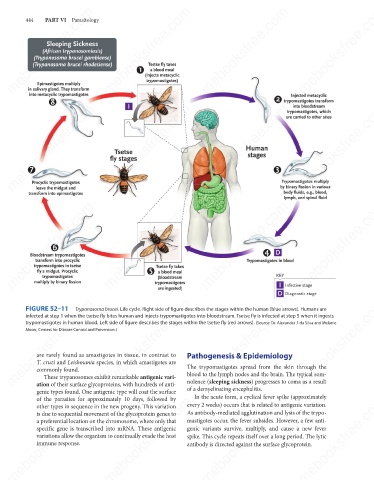
                 FIGURE 52–11
                                 Trypanosoma brucei. Life cycle. Right side of figure describes the stages within the human (blue arrows). Humans are
                 infected at step 1 when the tsetse fly bites human and injects trypomastigotes into bloodstream. Tsetse fly is infected at step 5 when it ingests
                 trypomastigotes in human blood. Left side of figure describes the stages within the tsetse fly (red arrows). (Source: Dr. Alexander J. da Silva and Melanie
                 Moser, Centers for Disease Control and Prevention.)


                    are rarely found as amastigotes in tissue, in contrast to
                    T. cruzi and Leishmania species, in which amastigotes are
                                                                     The trypomastigotes spread from the skin through the
                    commonly found.
                       These trypanosomes exhibit remarkable antigenic vari-
                                                                     nolence (sleeping sickness) progresses to coma as a result
                    ation of their surface glycoproteins, with hundreds of anti-
                                                                     of a demyelinating encephalitis.
                    genic types found. One antigenic type will coat the surface   blood to the lymph nodes and the brain. The typical som-
                                                                        In the acute form, a cyclical fever spike (approximately
                    of  the  parasites  for approximately  10 days,  followed  by
 mebooksfree.com  mebooksfree.com           mebooksfree.com          mastigotes occur, the fever subsides. However, a few anti-            mebooksfree.com
                                                                                                            mebooksfree.com
                                                                            mebooksfree.com
                                                                     every 2 weeks) occurs that is related to antigenic variation.
                    other types in sequence in the new progeny. This variation
                                                                     As antibody-mediated agglutination and lysis of the trypo-
                    is due to sequential movement of the glycoprotein genes to
                    a preferential location on the chromosome, where only that
                    specific gene is transcribed into mRNA. These antigenic
                                                                     genic variants survive, multiply, and cause a new fever
                    variations allow the organism to continually evade the host
                                                                     spike. This cycle repeats itself over a long period. The lytic
                    immune response.
                                                                     antibody is directed against the surface glycoprotein.


 mebooksfree.com  mebooksfree.com           mebooksfree.com                 mebooksfree.com                 mebooksfree.com                mebooksfree.com

