


Page 581 - Review of Medical Microbiology and Immunology ( PDFDrive )
P. 581
mebooksfree.com
mebooksfree.com
mebooksfree.com
Reiter’s syndromemebooksfree.com
mebooksfree.com
mebooksfree.com
mebooksfree.com mebooksfree.com mebooksfree.com TABLE 66–2 Microbial Infections Associated with mebooksfree.com
mebooksfree.com
mebooksfree.com
PART VII Immunology
570
because they bind poorly to those class I or class II MHC
Autoimmune Diseases
proteins on the surface of the thymic epithelium.
It should be noted, however, that whether a person
Microbe
Autoimmune Disease
develops an autoimmune disease or not is clearly multi-
factorial, because people with HLA genes known to pre-
Bacteria
Streptococcus pyogenes
dispose to certain autoimmune diseases nevertheless do
Guillain-Barré syndrome
Campylobacter jejuni
not develop the disease (e.g., many people carrying the
Primary biliary cirrhosis
Escherichia coli
HLA-DR4 gene do not develop rheumatoid arthritis).
Chlamydia trachomatis
That is to say, HLA genes appear to be necessary but not Viruses Rheumatic fever
Shigella species
Reiter’s syndrome
mebooksfree.com
mebooksfree.com mebooksfree.com mebooksfree.com 1 and measles virus, are also implicated as the possible cause of multiple sclerosis. No mebooksfree.com
mebooksfree.com
sufficient to cause autoimmune diseases. In general, class
Yersinia enterocolitica
Reactive arthritis
II MHC-related diseases (e.g., rheumatoid arthritis,
Lyme arthritis
Borrelia burgdorferi
Graves’ disease [hyperthyroidism], and systemic lupus
1
erythematosus) occur more commonly in women,
Hepatitis B virus
Multiple sclerosis
whereas class I MHC-related diseases (e.g., ankylosing
Hepatitis C virus
Mixed cryoglobulinemia
Allergic encephalitis
Measles virus
spondylitis and Reiter’s syndrome) occur more com-
2
Myocarditis
Coxsackie virus B3
monly in men.
3
Type 1 diabetes mellitus
Coxsackie virus B4
Cytomegalovirus
Scleroderma
HTLV-associated myelopathy
Human T-cell leukemia virus
Hormonal Factors
Other viruses, such as Epstein–Barr virus, human herpes virus-6, influenza A virus,
Approximately 90% of all autoimmune diseases occur in
women. Although the explanation for this markedly
virus has definitely been shown to be the environmental trigger at this time.
unequal gender ratio is unclear, there is some evidence
2
Coxsackie virus infects and kills cardiac myocytes, causing the acute symptoms, but
from animal models that estrogen can alter the B-cell rep-
mebooksfree.com
mebooksfree.com mebooksfree.com mebooksfree.com the late phase is caused by the attack of cytotoxic T cells on the myocytes. mebooksfree.com
mebooksfree.com
3
Causes diabetes mellitus in mice, but it is uncertain whether it is a cause in humans.
ertoire and enhance the formation of antibody to DNA.
Clinically, the observation that systemic lupus erythemato-
sus either appears or exacerbates during pregnancy (or
In summary, the current model is that autoimmune
diseases occur in people (1) with a genetic predisposition
immediately postpartum) supports the idea that hormones
play an important role in predisposing women to autoim-
that is determined by their MHC genes and (2) who are
mune diseases.
exposed to an environmental agent that triggers a cross-
reacting immune response against some component of
normal tissue. Furthermore, because autoimmune diseases
Environmental Factors
increase in number with advancing age, another possible
There are several environmental agents that trigger autoim-
mune diseases, most of which are either bacteria or viruses.
which allows any surviving autoreactive T cells to prolifer-
For example, pharyngitis caused by Streptococcus pyogenes
ate and cause disease.
predisposes to rheumatic fever. Other examples are factor is a decline in the number of regulatory T cells,
mebooksfree.com
mebooksfree.com mebooksfree.com mebooksfree.com been proposed. mebooksfree.com mebooksfree.com
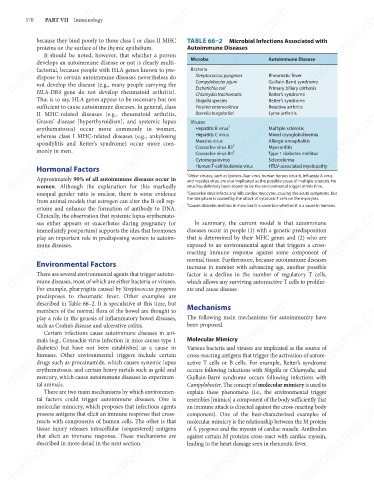
described in Table 66–2. It is speculative at this time, but
Mechanisms
members of the normal flora of the bowel are thought to
The following main mechanisms for autoimmunity have
play a role in the genesis of inflammatory bowel diseases,
such as Crohn’s disease and ulcerative colitis.
Certain infections cause autoimmune diseases in ani-
Molecular Mimicry
mals (e.g., Coxsackie virus infection in mice causes type 1
diabetes) but have not been established as a cause in
Various bacteria and viruses are implicated as the source of
humans. Other environmental triggers include certain
cross-reacting antigens that trigger the activation of autore-
drugs such as procainamide, which causes systemic lupus
active T cells or B cells. For example, Reiter’s syndrome
erythematosus, and certain heavy metals such as gold and
mercury, which cause autoimmune diseases in experimen-
Guillain-Barré syndrome occurs following infections with
tal animals.
Campylobacter. The concept of molecular mimicry is used to
There are two main mechanisms by which environmen- occurs following infections with Shigella or Chlamydia, and
explain these phenomena (i.e., the environmental trigger
mebooksfree.com mebooksfree.com mebooksfree.com molecular mimicry is the relationship between the M protein mebooksfree.com
mebooksfree.com
mebooksfree.com
tal factors could trigger autoimmune diseases. One is
resembles [mimics] a component of the body sufficiently that
molecular mimicry, which proposes that infectious agents
an immune attack is directed against the cross-reacting body
possess antigens that elicit an immune response that cross-
component). One of the best-characterized examples of
reacts with components of human cells. The other is that
tissue injury releases intracellular (sequestered) antigens
of S. pyogenes and the myosin of cardiac muscle. Antibodies
that elicit an immune response. These mechanisms are
against certain M proteins cross-react with cardiac myosin,
described in more detail in the next section.
leading to the heart damage seen in rheumatic fever.
mebooksfree.com mebooksfree.com mebooksfree.com mebooksfree.com mebooksfree.com mebooksfree.com

