


Page 14 - mathsvol1ch1to3ans
P. 14
14

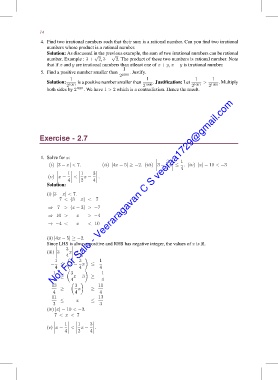
                     4. Find two irrational numbers such that their sum is a rational number. Can you find two irrational
                        numbers whose product is a rational number.
                        Solution: As discussed in the previous example, the sum of two irrational numbers can be rational
                                               √
                                                       √
                        number. Example : 3 +    2, 3 −  2. The product of these two numbers is rational number. Note
                        that if x and y are irrational numbers than atleast one of x + y, x − y is irrational number.
                                                             1
                     5. Find a positive number smaller than     . Justify.
                                                           2 1000
                                   1                                    1                       1       1
                        Solution:      is a positive number smaller than   . Justification: Let      >      . Multiply
                                 2 1001                               2 1000                  2 1001  2 1000
                        both sides by 2 1001 . We have 1 > 2 which is a contradiction. Hence the result.

                           Not For Sale - Veeraragavan C S veeraa1729@gmail.com


                    Exercise - 2.7


                     1. Solve for x:
                                                                                  3      1

                         (i) |3 − x| < 7.          (ii) |4x − 5| ≥ −2. (iii) 3 − x ≤ . (iv) |x| − 10 < −3


                                                                                  4      4

                                  1     1     3

                        (v) x −       <     x −     .

                                  4        2  4
                        Solution:
                        (i) |3 − x| < 7.
                            −7 < (3 − x) < 7
                        ⇒ 7 > (x − 3) > −7
                        ⇒ 10 >        x     > −4
                        ⇒ −4 <        x     < 10


                        (ii) |4x − 5| ≥ −2.
                        Since LHS is always positive and RHS has negative integer, the values of x is R.

                                 3      1

                        (iii) 3 − x ≤ .


                                 4      4

                            1          3         1
                          −   ≤    3 − x     ≤
                            4          4         4

                           1       3              1
                              ≥      x − 3   ≥ −
                           4       4              4

                          13         3           11
                              ≥        x     ≥
                           4         4           4
                          11                     13
                              ≤       x      ≤
                           3                     3
                        (iv) |x| − 10 < −3.
                          −7 < x < 7

                                1      1     3

                        (v) x −      <     x −    .

                                4       2    4

