


Page 17 - 9780077418427.pdf
P. 17
Volume/207/MHDQ243/tiL12214_disk1of1/0073512214/tiL12214_pagefiles
tiL12214_fm_i-xx.indd Page xiv 25/10/10 8:59 AM user-f463
tiL12214_fm_i-xx.indd Page xiv 25/10/10 8:59 AM user-f463 Volume/207/MHDQ243/tiL12214_disk1of1/0073512214/tiL12214_pagefile
Chapter Outline
The chapter outline includes all the major topic headings and OVERVIEW
subheadings within the body of the chapter. It gives you a quick Chapters 2–5 have been concerned with mechanical concepts, explanations of the motion of objects that exert forces on
one another. These concepts were used to explain straight-line motion, the motion of free fall, and the circular motion
glimpse of the chapter’s contents and helps you locate sections of objects on Earth as well as the circular motion of planets and satellites. The mechanical concepts were based on
Newton’s laws of motion and are sometimes referred to as Newtonian physics. The mechanical explanations were then
dealing with particular topics. extended into the submicroscopic world of matter through the kinetic molecular theory. The objects of motion were now
particles, molecules that exert force on one another, and concepts associated with heat were interpreted as the motion of
these particles. In a further extension of Newtonian concepts, mechanical explanations were given for concepts associated
with sound, a mechanical disturbance that follows the laws of motion as it moves through the molecules of matter.
You might wonder, as did the scientists of the 1800s, if mechanical interpretations would also explain other natural
phenomena such as electricity, chemical reactions, and light. A mechanical model would be very attractive because it
already explained so many other facts of nature, and scientists have always looked for basic, unifying theories. Mechanical
interpretations were tried, as electricity was considered a moving fluid, and light was considered a mechanical wave
moving through a material fluid. There were many unsolved puzzles with such a model, and gradually it was recognized
that electricity, light, and chemical reactions could not be explained by mechanical interpretations. Gradually, the point
of view changed from a study of particles to a study of the properties of the space around the particles. In this chapter,
you will learn about electric charge in terms of the space around particles. This model of electric charge, called the field
model, will be used to develop concepts about electric current, the electric circuit, and electrical work and power. A
relationship between electricity and the fascinating topic of magnetism is discussed next, including what magnetism is
and how it is produced. Then the relationship is used to explain the mechanical production of electricity (Figure 6.1), how
electricity is measured, and how electricity is used in everyday technological applications.
6.1 CONCEPTS OF ELECTRICITY
6 Electricity You are familiar with the use of electricity in many electrical amber. The word electricity is also based on the Greek word
for amber.
Today, we understand that the basic unit of matter is the atom,
devices such as lights, toasters, radios, and calculators. You are
which is made up of electrons and other particles such as protons
also aware that electricity is used for transportation and for heat-
and neutrons. The atom is considered to have a dense center part
ing and cooling places where you work and live. Many people
accept electrical devices as part of their surroundings, with only a called a nucleus that contains the closely situated protons and neu-
trons. The electrons move around the nucleus at some relatively
hazy notion of how they work. To many people, electricity seems greater distance (Figure 6.2). Details on the nature of protons, neu-
to be magical. Electricity is not magical, and it can be understood, trons, electrons, and models of how the atom is constructed will be
just as we understand any other natural phenomenon. There are considered in chapter 8. For understanding electricity, you need
theories that explain observations, quantities that can be mea- only consider the protons in the nucleus, the electrons that move
sured, and relationships between these quantities, or laws, that around the nucleus, and the fact that electrons can be moved from
lead to understanding. All of the observations, measurements, an atom and caused to move to or from one object to another.
A thunderstorm produces an interesting display of electrical discharge. and laws begin with an understanding of electric charge. Basically, the electrical, light, and chemical phenomena involve
Each bolt can carry over 150,000 amperes of current with a voltage
of 100 million volts. the electrons and not the more massive nucleus. The massive nuclei
ELECTRON THEORY OF CHARGE remain in a relatively fixed position in a solid, but some of the elec-
trons can move about from atom to atom.
It was a big mystery for thousands of years. No one could
CORE CONCEPT figure out why a rubbed piece of amber, which is fossilized
tree resin, would attract small pieces of paper (papyrus), Electric Charge
Electric and magnetic fields interact and can produce forces.
thread, and hair. This unexplained attraction was called the Electrons and protons have a property called electric charge.
amber effect. Then about one hundred years ago, J. J. Thom- Electrons have a negative electric charge, and protons have a
OUTLINE son (1856–1940) found the answer while experimenting with positive electric charge. The negative or positive description sim-
electric currents. From these experiments, Thomson was able ply means that these two properties are opposite; it does not
to conclude that negatively charged particles were present mean that one is better than the other. Charge is as fundamental
6.1 Concepts of Electricity
Static Electricity Electron Theory of Charge in all matter and in fact might be the stuff of which matter is to these subatomic particles as gravity is to masses. This means
Static electricity is an electric Electric Charge Measuring Electrical Charge
charge confined to an object Static Electricity The size of a static charge is made. The amber effect was traced to the movement of these that you cannot separate gravity from a mass, and you cannot
separate charge from an electron or a proton.
particles, so they were called electrons after the Greek word for
from the movement of electrons. Electrical Conductors and Insulators related to the number of electrons
Measuring Electrical Charges that were moved, and this can be
Electrostatic Forces measured in units of coulombs. 140 CHAPTER 6 Electricity 6-2
Force Fields
Electric Potential
Force Field 6.2 Electric Current
The space around a charge is The Electric Circuit Electric Potential
changed by the charge, and this The Nature of Current Electric potential results when
is called an electric field. Electrical Resistance work is done moving charges into
Electrical Power and Electrical Work or out of an electric field, and
People Behind the Science: Benjamin Franklin the potential created between
The Electric Circuit 6.3 Magnetism two points is measured in volts. EXAMPLES
Magnetic Poles
Electric current is the rate at Magnetic Fields
which charge moves. The Source of Magnetic Fields
Permanent Magnets Source of Magnetic Fields
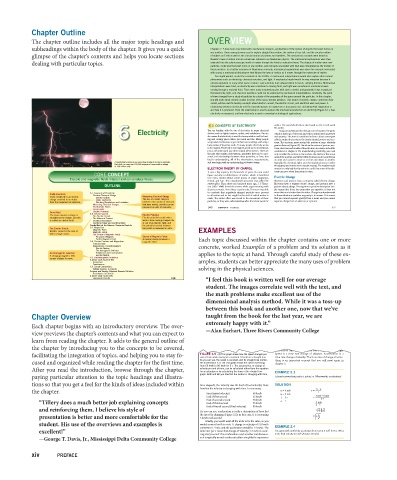
Earth’s Magnetic Field A moving charge produces a Each topic discussed within the chapter contains one or more
6.4 Electric Currents and Magnetism magnetic field.
Current Loops
Applications of Electromagnets concrete, worked Examples of a problem and its solution as it
Electric Meters
Electromagnetic Switches
Electromagnetic Induction Telephones and Loudspeakers applies to the topic at hand. Through careful study of these ex-
Electric Motors
A changing magnetic field 6.5 Electromagnetic Induction
causes charges to move.
A Closer Look: Current War
Generators amples, students can better appreciate the many uses of problem
Transformers
6.6 Circuit Connections
Voltage Sources in Circuits solving in the physical sciences.
Science and Society: Blackout Reveals Pollution
Resistances in Circuits
A Closer Look: Solar Cells
“I feel this book is written well for our average
Household Circuits 139
student. The images correlate well with the text, and
the math problems make excellent use of the
dimensional analysis method. While it was a toss-up
between this book and another one, now that we’ve
Ch apter Overview taught from the book for the last year, we are
extremely happy with it.”
Each chapter begins with an introductory overview. The over-
—Alan Earhart, Three Rivers Community College
view previews the chapter’s contents and what you can expect to
learn from reading the chapter. It adds to the general outline of
the chapter by introducing you to the concepts to be covered, B Time (s)
This shows that both equations are a time rate of change.
facilitating the integration of topics, and helping you to stay fo- FIGURE 2.5 (A) This graph shows how the speed changes per Speed is a time rate change of distance. Acceleration is a
time rate change of velocity. The time rate of change of some-
unit of time while driving at a constant 70 km/h in a straight line.
As you can see, the speed is constant, and for straight-line motion, thing is an important concept that you will meet again in
cused and organized while reading the chapter for the first time. the acceleration is 0. (B) This graph shows the speed increasing chapter 3.
from 60 km/h to 80 km/h for 5 s. The acceleration, or change of
After you read the introduction, browse through the chapter, velocity per unit of time, can be calculated either from the equation EXAMPLE 2.3
for acceleration or by calculating the slope of the straight-line
graph. Both will tell you how fast the motion is changing with time.
paying particular attention to the topic headings and illustra- A bicycle moves from rest to 5 m/s in 5 s. What was the acceleration?
tions so that you get a feel for the kinds of ideas included within time elapsed), the velocity was 80 km/h (final velocity). Note SOLUTION
how fast the velocity is changing with time. In summary, v _
the chapter. Start (initial velocity) 60 km/h v i = 0 m/s a = f – v i
t
v f = 5 m/s
5 m/s – 0 m/s
End of first second 65 km/h t = 5 s = __
End of second second 70 km/h 5 s
“Tillery does a much better job explaining concepts End of third second 75 km/h a = ? = _ _
5 m/s
End of fourth second (final velocity) 80 km/h 5 s
and reinforcing them. I believe his style of As you can see, acceleration is really a description of how fast = 1 ( m _ ) ( 1 _ s )
s
the speed is changing (Figure 2.5); in this case, it is increasing
presentation is better and more comfortable for the 5 km/h each second. = 1 m _
2
s
Usually, you would want all the units to be the same, so you
student. His use of the overviews and examples is would convert km/h to m/s. A change in velocity of 5.0 km/h
converts to 1.4 m/s, and the acceleration would be 1.4 m/s/s. The EXAMPLE 2.4
excellent!” units m/s per s mean that change of velocity (1.4 m/s) is occur- An automobile uniformly accelerates from rest at 5 m/s 2 for 6 s. What
ring every second. The combination m/s/s is rather cumbersome, is the final velocity in m/s? (Answer: 30 m/s)
—George T. Davis, Jr., Mississippi Delta Community College so it is typically treated mathematically to simplify the expression
xiv PREFACE

