


Page 674 - 9780077418427.pdf
P. 674
Volume/207/MHDQ243/tiL12214_disk1of1/0073512214/tiL12214_pagefiles
tiL12214_appe_643-698.indd Page 651 09/10/10 8:37 AM user-f463
tiL12214_appe_643-698.indd Page 651 09/10/10 8:37 AM user-f463 Volume/207/MHDQ243/tiL12214_disk1of1/0073512214/tiL12214_pagefile
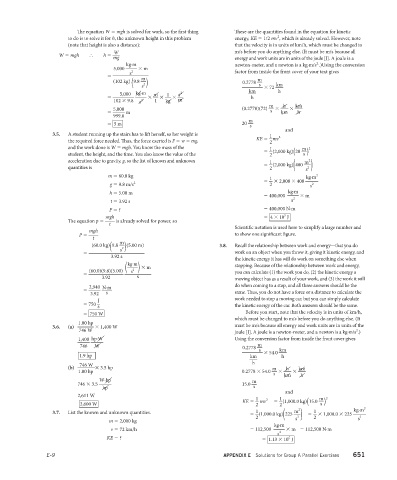
Th e equation W = mgh is solved for work, so the fi rst thing These are the quantities found in the equation for kinetic
2
to do is to solve it for h, the unknown height in this problem energy, KE = 1/2 mv , which is already solved. However, note
(note that height is also a distance): that the velocity is in units of km/h, which must be changed to
W _ m/s before you do anything else. (It must be m/s because all
W = mgh ∴ h = energy and work units are in units of the joule [J]. A joule is a
mg
2.
kg·m
_ newton-meter, and a newton is a kg·m/s .)Using the conversion
5,000 × m
2
__ factor from inside the front cover of your text gives
s
= m _
m _
(
2)
(102 kg) 9.8 _ 72
0.2778
_
km
s
s
×
_
km
5,000 kg·m
2
_ _ _ _ _ h
s
m
1
= × × × h
102 × 9.8 s 2 1 kg m
m _ _ _
km
h
_
5,000 (0.2778)(72) × ×
= m s km h
999.6
m _
= 5 m 20
s
and
3.5. A student running up the stairs has to lift herself, so her weight is 1 _ 2
the required force needed. Thus, the force exerted is F = w = mg, KE = mv
2
and the work done is W = mgh. You know the mass of the 1 _ m _ 2
= (2,000 kg)( 20 )
student, the height, and the time. You also know the value of the 2 s
acceleration due to gravity, g, so the list of known and unknown 1 _ m _ 2
(
2)
= (2,000 kg) 400
quantities is 2 s
m = 60.0 kg 1 _ kg·m 2
_
g = 9.8 m/s 2 = × 2,000 × 400 s 2
2
kg·m
h = 5.00 m _
= 400,000 2 × m
t = 3.92 s s
P = ? = 400,000 N·m
5
mgh
_ = 4 × 10 J
Th e equation p = is already solved for power, so
t
Scientific notation is used here to simplify a large number and
mgh
_
P = to show one signifi cant fi gure.
t
m _
2)
(
(60.0 kg) 9.8 (5.00 m) 3.8. Recall the relationship between work and energy—that you do
___
s
= work on an object when you throw it, giving it kinetic energy, and
3.92 s
the kinetic energy it has will do work on something else when
( ) stopping. Because of the relationship between work and energy,
kg⋅m
_
× m
(60.0)(9.8)(5.00) s 2 you can calculate (1) the work you do, (2) the kinetic energy a
__ __
=
3.92 s moving object has as a result of your work, and (3) the work it will
_ _ do when coming to a stop, and all three answers should be the
2,940 N·m
= same. Thus, you do not have a force or a distance to calculate the
3.92 s
_ J work needed to stop a moving car, but you can simply calculate
= 750 the kinetic energy of the car. Both answers should be the same.
s
= 750 W Before you start, note that the velocity is in units of km/h,
which must be changed to m/s before you do anything else. (It
1.00 hp
_ must be m/s because all energy and work units are in units of the
3.6. (a) × 1,400 W
746 W joule [J]. A joule is a newton-meter, and a newton is a kg·m/s .)
2
1,400 hp·W
_ _ Using the conversion factor from inside the front cover gives
m _
746 W 0.2778
_
_ 54.0
s
km
×
1.9 hp _ h
km
_ h
746 W
×
(b) 3.5 hp m _ _ _
km
h
1.00 hp 0.2778 × 54.0 × ×
s km h
W·hp
_ m _
746 × 3.5 15.0
hp s
and
2,611 W 1 _ 1 _ m _ 2
2
KE = mv = (1,000.0 kg) ( 15.0 )
2,600 W 2 2 s 2
2
2)
1 _
_
(
m _
1 _
3.7. List the known and unknown quantities. = (1,000.0 kg) 225 = × 1,000.0 × 225 kg·m
2 s 2 s 2
m = 2,000 kg
kg·m
_
v = 72 km/h = 112,500 × m = 112,500 N·m
s 2
KE = ? = 1.13 × 10 J
5
E-9 APPENDIX E Solutions for Group A Parallel Exercises 651

