


Page 672 - 9780077418427.pdf
P. 672
Volume/207/MHDQ243/tiL12214_disk1of1/0073512214/tiL12214_pagefiles
tiL12214_appe_643-698.indd Page 649 09/10/10 8:37 AM user-f463
tiL12214_appe_643-698.indd Page 649 09/10/10 8:37 AM user-f463 Volume/207/MHDQ243/tiL12214_disk1of1/0073512214/tiL12214_pagefile
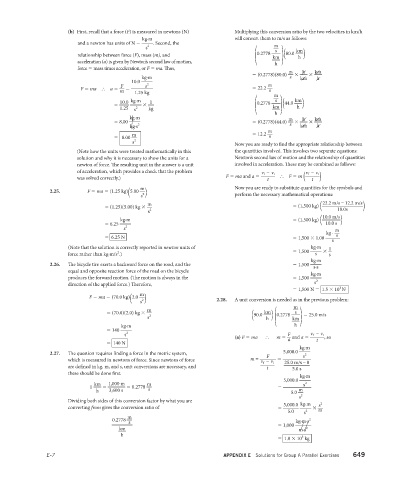
(b) First, recall that a force (F) is measured in newtons (N) Multiplying this conversion ratio by the two velocities in km/h
kg·m will convert them to m/s as follows:
_
and a newton has units of N = . Second, the
(
s 2 m _ _
s _
km
)
80.0
relationship between force (F), mass (m), and 0.2778 ) ( h
_
km
acceleration (a) is given by Newton’s second law of motion, h
force = mass times acceleration, or F = ma. Th us,
m _ _ _
h
km
= (0.2778)(80.0) × ×
kg·m
_ s km h
10.0
2
F _ _ m _
s
F = ma ∴ a = = = 22.2
m 1.25 kg s m _
(
s _
km
)
_ kg·m 1 0.2778 ) ( _
10.0 _ _
44.0
= ×
km
1.25 s 2 kg _ h
h
kg·m m _ _ _
_
h
km
= 8.00 = (0.2778)(44.0) × ×
kg·s 2 s km h
m _
m _ = 12.2
= 8.00 s
s 2
Now you are ready to find the appropriate relationship between
(Note how the units were treated mathematically in this the quantities involved. This involves two separate equations:
solution and why it is necessary to show the units for a Newton’s second law of motion and the relationship of quantities
newton of force. The resulting unit in the answer is a unit involved in acceleration. These may be combined as follows:
of acceleration, which provides a check that the problem _ _
v f – v i
v f – v i
was solved correctly.) F = ma and a = t ∴ F = m ( t )
m _
(
2)
2.25. F = ma = (1.25 kg) 5.00 Now you are ready to substitute quantities for the symbols and
s perform the necessary mathematical operations:
22.2 m/s – 12.2 m/s
m _ ( __ )
= (1.25)(5.00) kg × = (1,500 kg) 10.0s
s 2
)
10.0 m/s
(
kg·m
_ = (1,500 kg) _
= 6.25 10.0 s
s 2 m _
kg ·
s
= 6.25 N = 1,500 × 1.00 _
s
(Note that the solution is correctly reported in newton units of _ _
kg·m
1
2
force rather than kg·m/s .) = 1,500 s ×
s
kg·m
_
2.26. The bicycle tire exerts a backward force on the road, and the = 1,500 s·s
equal and opposite reaction force of the road on the bicycle kg·m
produces the forward motion. (The motion is always in the = 1,500 _
2
direction of the applied force.) Th erefore, s
3
= 1,500 N = 1.5 × 10 N
m _
2)
(
F = ma = (70.0 kg) 2.0
s 2.28. A unit conversion is needed as in the previous problem:
m _
(
m _
s _
_
km
)
= (70.0)(2.0) kg × ( 90.0 0.2778 )
= 25.0 m/s
s 2 h _
km
kg·m
_ h
= 140
s 2 F _ _
v f – v i
,
(a) F = ma ∴ m = and a = so
a
= 140 N t
kg·m
_
5,000.0
2.27. The question requires finding a force in the metric system, _ __
2
F
s
which is measured in newtons of force. Since newtons of force m = _ = __
25.0 m/s – 0
v f – v i
are defined in kg, m, and s, unit conversions are necessary, and t 5.0 s
these should be done fi rst.
kg·m
_
5,000.0
2
_ _ m _ __
1,000 m
km
s
1 = = 0.2778 =
m _
h 3,600 s s 5.0
s 2
Dividing both sides of this conversion factor by what you are
5,000.0 kg·m s 2
_ _ _
converting from gives the conversion ratio of = ×
5.0 s 2 m
m _
0.2778
kg·m·s
_ = 1,000 _ 2
s
_ m·s 2
km
h 3
= 1.0 × 10 kg
E-7 APPENDIX E Solutions for Group A Parallel Exercises 649

