


Page 713 - 9780077418427.pdf
P. 713
Volume/207/MHDQ243/tiL12214_disk1of1/0073512214/tiL12214_pagefiles
tiL12214_appe_643-698.indd Page 690 09/10/10 8:37 AM user-f463
tiL12214_appe_643-698.indd Page 690 09/10/10 8:37 AM user-f463 Volume/207/MHDQ243/tiL12214_disk1of1/0073512214/tiL12214_pagefile
life-forms could have only coexisted during the Late Siluran Convert the thickness of the atmosphere to centimeters
through Late Devonian. _
5
1 × 10 cm
5.6 km ( )
km
5
Geologic Brachiopod Coral Echinoderm 5.6 × 10 cm
5
−8
Period z layer = 7.17 × 10 (5.6 × 10 cm)
Permian = 4.0 × 10 cm
−2
Mississippian
22.2. Determine the conversion ratio (CR) based on ratio of
Devonian the thickness of the sheet of plastic to the thickness of
Late
Silurian 99 percent of the mass of Earth’s atmosphere:
Silurian
Ordovician through Late z plastic sheet = 1.0 mm
1
Cambrian Devonian z Earth = 3.2 × 10 km
CR = ?
z plastic sheet
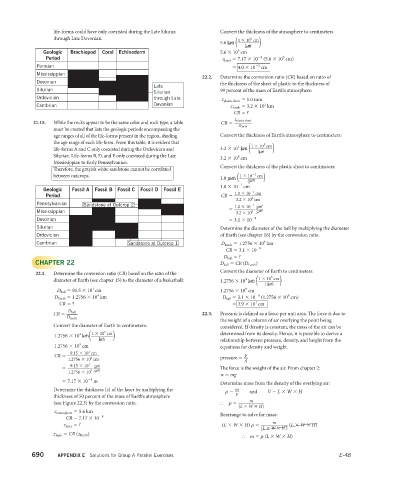
21.15. While the rocks appear to be the same color and rock type, a table CR = _
z Earth
must be created that lists the geologic periods encompassing the
age ranges of all of the life-forms present in the region, shading Convert the thickness of Earth’s atmosphere to centimeters:
the age range of each life-form. From this table, it is evident that 5
1 × 10 cm
1
life-forms A and C only coexisted during the Ordovician and 3.2 × 10 km ( _ )
km
Silurian. Life-forms B, D, and E only coexisted during the Late 6
3.2 × 10 cm
Mississippian to Early Pennsylvanian.
Convert the thickness of the plastic sheet to centimeters:
Therefore, the grayish white sandstone cannot be correlated
−1
1 × 10 cm
between outcrops. _
1.0 mm ( mm )
−1
1.0 × 10 cm
Geologic Fossil A Fossil B Fossil C Fossil D Fossil E −1
1.0 × 10 cm
Period CR = __
6
3.2 × 10 cm
Pennsylvanian Sandstone at Outcrop 2 −1
_ cm
= 1.0 × 10 _
Mississippian 3.2 × 10 6 cm
Devonian = 3.1 × 10 −8
Silurian Determine the diameter of the ball by multiplying the diameter
Ordovician of Earth (see chapter 16) by the conversion ratio.
4
Cambrian Sandstone at Outcrop 1 D Earth = 1.2756 × 10 km
CR = 3.1 × 10 −8
D ball = ?
CHAPTER 22 D ball = CR (D Earth )
22.1. Determine the conversion ratio (CR) based on the ratio of the Convert the diameter of Earth to centimeters:
5
1 × 10 cm
diameter of Earth (see chapter 15) to the diameter of a basketball: 1.2756 × 10 km ( _ )
4
1 km
9
1
D ball = 91.5 × 10 cm 1.2756 × 10 cm
−8
9
4
D Earth = 1.2756 × 10 km D ball = 3.1 × 10 (1.2756 × 10 cm)
1
CR = ? = 3.9 × 10 cm
_
D ball
CR = 22.3. Pressure is defined as a force per unit area. The force is due to
D Earth
the weight of a column of air overlying the point being
Convert the diameter of Earth to centimeters: considered. If density is constant, the mass of the air can be
5
1 × 10 cm
4
1.2756 × 10 km ( _ ) determined from its density. Hence, it is possible to derive a
km relationship between pressure, density, and height from the
9
1.2756 × 10 cm equations for density and weight.
__
1
9.15 × 10 cm
CR = F _
9
1.2756 × 10 cm pressure =
A
1
9.15 × 10 _
= _ cm The force is the weight of the air. From chapter 2:
9 cm
1.2756 × 10
w = mg
−8
= 7.17 × 10 m
Determine mass from the density of the overlying air:
Determine the thickness (z) of the layer by multiplying the m _
ρ = and V = L × W × H
thickness of 50 percent of the mass of Earth’s atmosphere V
m
(see Figure 22.3) by the conversion ratio. ∴ ρ = __
(L × W × H)
z atmosphere = 5.6 km
CR = 7.17 × 10 −8 Rearrange to solve for mass:
m
z layer = ? (L × W × H) ρ = __ × W × H)
(
L
(L × W × H )
z layer = CR (z Earth )
∴ m = ρ (L × W × H)
690 APPENDIX E Solutions for Group A Parallel Exercises E-48

