


Page 717 - 9780077418427.pdf
P. 717
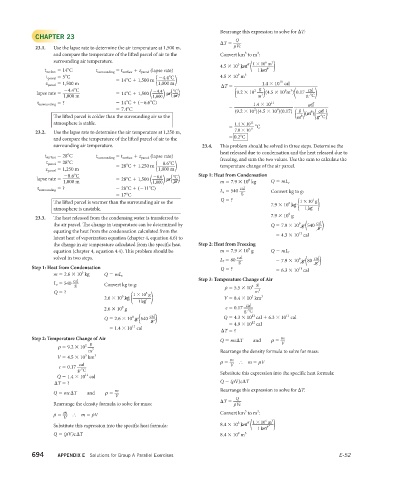
Volume/207/MHDQ243/tiL12214_disk1of1/0073512214/tiL12214_pagefile
tiL12214_appe_643-698.indd Page 694 09/10/10 8:37 AM user-f463
tiL12214_appe_643-698.indd Page 694 09/10/10 8:37 AM user-f463 Volume/207/MHDQ243/tiL12214_disk1of1/0073512214/tiL12214_pagefiles
Rearrange this expression to solve for ΔT:
CHAPTER 23
Q
_
ΔT =
23.1. Use the lapse rate to determine the air temperature at 1,500 m, ρVc
3
and compare the temperature of the lifted parcel of air to the Convert km to m : 3
surrounding air temperature. 6 3
3 )
(
3 1 × 10 m
3
4.5 × 10 km _
o
t surface = 14 C t surrounding = t surface + z parcel (lapse rate) 1 km
9
t parcel = 5°C _ 4.5 × 10 m 3
)
(
−4.4°C
= 14°C + 1,500 m
11
1.4 × 10 cal
z parcel = 1,500 m 1,000 m ____
ΔT =
g
(
_ −4.4 °C _ 2 _ 9 3 _
3)
cal
−4.4°C
(
)
lapse rate = = 14°C + 1,500 _ m ( ) ( 9.2 × 10 (4.5 × 10 m ) 0.17 g⋅°C)
1,000 m 1,000 m m
t surrounding = ? = 14°C + (−6.6°C) ___ __
11
1.4 × 10
cal
= 7.4°C = (9.2 × 10 )(4.5 × 10 )(0.17) _ 3 _
2
g
9
3) ( g⋅°C)
cal
Th e lifted parcel is colder than the surrounding air so the ( (m )
m
atmosphere is stable. _
11
1.4 × 10
°
= 11 C
23.2. Use the lapse rate to determine the air temperature at 1,250 m, 7.0 × 10
and compare the temperature of the lifted parcel of air to the = 0.2°C
surrounding air temperature. 23.4. This problem should be solved in three steps. Determine the
o
t surface = 28 C t surrounding = t surface + z parcel (lapse rate) heat released due to condensation and the heat released due to
)
(
t parcel = 28°C _ freezing, and sum the two values. Use the sum to calculate the
−8.6°C
= 28°C + 1,250 m temperature change of the air parcel.
z parcel = 1,250 m 1,000 m
_ _ °C _ Step 1: Heat from Condensation
−8.6°C
−8.6
)
(
lapse rate = = 28°C + 1,500 m ( ) 6
1,000 m 1,000 m m = 7.9 × 10 kg Q = mL v
cal _
t surrounding = ? = 28°C + (−11°C) L v = 540 Convert kg to g:
= 17°C g
)
(
3
1 × 10 g
Th e lifted parcel is warmer than the surrounding air so the Q = ? 7.9 × 10 kg _
6
atmosphere is unstable. 1 kg
9
23.3. The heat released from the condensing water is transferred to 7.9 × 10 g
cal _
9
the air parcel. The change in temperature can be determined by Q = 7.9 × 10 g ( 540 )
g
equating the heat from the condensation calculated from the 12
latent heat of vaporization equation (chapter 4, equation 4.6) to = 4.3 × 10 cal
the change in air temperature calculated from the specifi c heat Step 2: Heat from Freezing
9
equation (chapter 4, equation 4.4). This problem should be m = 7.9 × 10 g Q = mL f
cal _
solved in two steps. L f = 80 = 7.9 × 10 g ( 80 )
cal _
9
g
g
Step 1: Heat from Condensation Q = ? = 6.3 × 10 cal
11
5
m = 2.6 × 10 kg Q = mL v
cal _ Step 3: Temperature Change of Air
L v = 540 Convert kg to g: 2 _
g
g
ρ = 5.5 × 10
Q = ? 1 × 10 g m 3
(
)
3
3
5
2.6 × 10 kg _ V = 8.4 × 10 km 3
1 kg
_
cal
8
2.6 × 10 g c = 0.17
g⋅°C
11
cal _
12
8
Q = 2.6 × 10 g ( 540 ) Q = 4.3 × 10 cal + 6.3 × 10 cal
g
12
= 4.9 × 10 cal
11
= 1.4 × 10 cal
ΔT = ?
m _
Step 2: Temperature Change of Air Q = mcΔT and ρ =
g
2 _ V
ρ = 9.2 × 10
m 3 Rearrange the density formula to solve for mass:
3
V = 4.5 × 10 km 3 m _
ρ = ∴ m = ρV
cal
_ V
c = 0.17
g⋅°C Substitute this expression into the specific heat formula:
11
Q = 1.4 × 10 cal
ΔT = ? Q = (ρV)cΔT
m _ Rearrange this expression to solve for ΔT:
Q = mc ΔT and ρ =
V Q
_
ΔT =
Rearrange the density formula to solve for mass: ρVc
3
m _ Convert km to m : 3
ρ = ∴ m = ρV
V 6 3
(
3 )
3 1 × 10 m
3
Substitute this expression into the specific heat formula: 8.4 × 10 km _
1 km
9
Q = (ρV)c ΔT 8.4 × 10 m 3
694 APPENDIX E Solutions for Group A Parallel Exercises E-52

