


Page 110 - HOW TO PROVE IT: A Structured Approach, Second Edition
P. 110
P1: PIG/
                   0521861241c03  CB996/Velleman  October 20, 2005  2:42  0 521 86124 1  Char Count= 0


                                   96                          Proofs
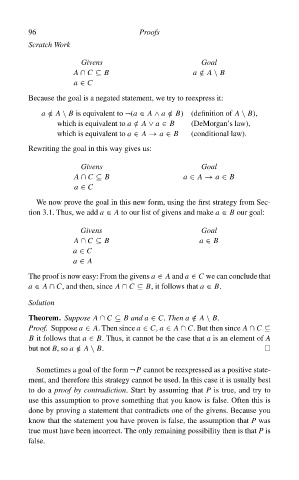
                                   Scratch Work
                                                Givens                         Goal
                                              A ∩ C ⊆ B                      a /∈ A \ B
                                              a ∈ C
                                   Because the goal is a negated statement, we try to reexpress it:

                                      a /∈ A \ B is equivalent to ¬(a ∈ A ∧ a /∈ B)  (definition of A \ B),
                                          which is equivalent to a /∈ A ∨ a ∈ B  (DeMorgan’s law),
                                          which is equivalent to a ∈ A → a ∈ B  (conditional law).
                                   Rewriting the goal in this way gives us:

                                                Givens                         Goal
                                              A ∩ C ⊆ B                   a ∈ A → a ∈ B
                                              a ∈ C

                                     We now prove the goal in this new form, using the first strategy from Sec-
                                   tion 3.1. Thus, we add a ∈ A to our list of givens and make a ∈ B our goal:

                                                Givens                         Goal
                                              A ∩ C ⊆ B                       a ∈ B
                                              a ∈ C
                                              a ∈ A

                                   The proof is now easy: From the givens a ∈ A and a ∈ C we can conclude that
                                   a ∈ A ∩ C, and then, since A ∩ C ⊆ B, it follows that a ∈ B.

                                   Solution
                                   Theorem. Suppose A ∩ C ⊆ B and a ∈ C. Then a /∈ A \ B.
                                   Proof. Suppose a ∈ A. Then since a ∈ C, a ∈ A ∩ C. But then since A ∩ C ⊆
                                   B it follows that a ∈ B. Thus, it cannot be the case that a is an element of A
                                   but not B,so a /∈ A \ B.


                                     Sometimes a goal of the form ¬P cannot be reexpressed as a positive state-
                                   ment, and therefore this strategy cannot be used. In this case it is usually best
                                   to do a proof by contradiction. Start by assuming that P is true, and try to
                                   use this assumption to prove something that you know is false. Often this is
                                   done by proving a statement that contradicts one of the givens. Because you
                                   know that the statement you have proven is false, the assumption that P was
                                   true must have been incorrect. The only remaining possibility then is that P is
                                   false.

