


Page 112 - HOW TO PROVE IT: A Structured Approach, Second Edition
P. 112
P1: PIG/
                   0521861241c03  CB996/Velleman  October 20, 2005  2:42  0 521 86124 1  Char Count= 0


                                   98                          Proofs
                                   between these two sentences. The givens–goal list summarizes what we know
                                   and what we have to prove in order to solve this problem.
                                     The goal x  = 3 means ¬(x = 3), but because x = 3 has no logical connec-
                                   tives in it, none of the equivalences we know can be used to reexpress this goal
                                   in a positive form. We therefore try proof by contradiction and transform the
                                   problem as follows:
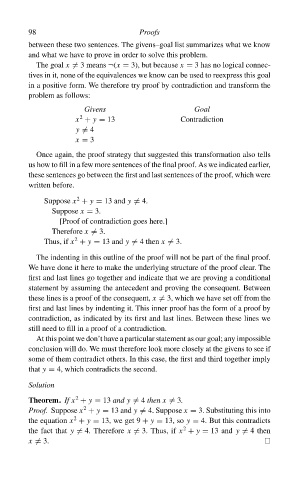
                                                 Givens                      Goal
                                                2
                                               x + y = 13                Contradiction
                                               y  = 4
                                               x = 3
                                     Once again, the proof strategy that suggested this transformation also tells
                                   us how to fill in a few more sentences of the final proof. As we indicated earlier,
                                   these sentences go between the first and last sentences of the proof, which were
                                   written before.
                                               2
                                       Suppose x + y = 13 and y  = 4.
                                         Suppose x = 3.
                                           [Proof of contradiction goes here.]
                                         Therefore x  = 3.
                                              2
                                       Thus, if x + y = 13 and y  = 4 then x  = 3.
                                     The indenting in this outline of the proof will not be part of the final proof.
                                   We have done it here to make the underlying structure of the proof clear. The
                                   first and last lines go together and indicate that we are proving a conditional
                                   statement by assuming the antecedent and proving the consequent. Between
                                   these lines is a proof of the consequent, x  = 3, which we have set off from the
                                   first and last lines by indenting it. This inner proof has the form of a proof by
                                   contradiction, as indicated by its first and last lines. Between these lines we
                                   still need to fill in a proof of a contradiction.
                                     At this point we don’t have a particular statement as our goal; any impossible
                                   conclusion will do. We must therefore look more closely at the givens to see if
                                   some of them contradict others. In this case, the first and third together imply
                                   that y = 4, which contradicts the second.

                                   Solution
                                               2
                                   Theorem. If x + y = 13 and y  = 4 then x  = 3.
                                                 2
                                   Proof. Suppose x + y = 13 and y  = 4. Suppose x = 3. Substituting this into
                                              2
                                   the equation x + y = 13, we get 9 + y = 13, so y = 4. But this contradicts
                                                                          2
                                   the fact that y  = 4. Therefore x  = 3. Thus, if x + y = 13 and y  = 4 then
                                   x  = 3.

