


Page 16 - HOW TO PROVE IT: A Structured Approach, Second Edition
P. 16
P1: PiG/
                   0521861241int  CB996/Velleman  October 18, 2005  17:26  0 521 86124 1  Char Count= 0


                                   2                         Introduction
                                   patterns in mathematics just by trying out a calculation on a few numbers.
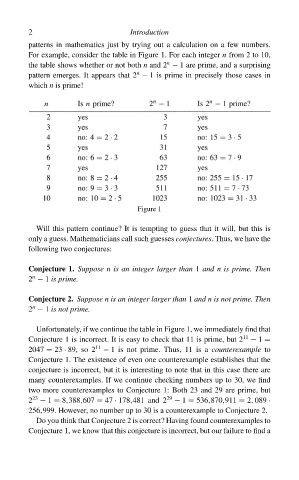
                                   For example, consider the table in Figure 1. For each integer n from 2 to 10,
                                                                      n
                                   the table shows whether or not both n and 2 − 1 are prime, and a surprising
                                                              n
                                   pattern emerges. It appears that 2 − 1 is prime in precisely those cases in
                                   which n is prime!


                                                              Figure 1

                                     Will this pattern continue? It is tempting to guess that it will, but this is
                                   only a guess. Mathematicians call such guesses conjectures. Thus, we have the
                                   following two conjectures:


                                   Conjecture 1. Suppose n is an integer larger than 1 and n is prime. Then
                                    n
                                   2 − 1 is prime.
                                   Conjecture 2. Suppose n is an integer larger than 1 and n is not prime. Then
                                    n
                                   2 − 1 is not prime.
                                     Unfortunately, if we continue the table in Figure 1, we immediately find that
                                                                                         11
                                   Conjecture 1 is incorrect. It is easy to check that 11 is prime, but 2 − 1 =
                                                    11
                                   2047 = 23 · 89, so 2 − 1 is not prime. Thus, 11 is a counterexample to
                                   Conjecture 1. The existence of even one counterexample establishes that the
                                   conjecture is incorrect, but it is interesting to note that in this case there are
                                   many counterexamples. If we continue checking numbers up to 30, we find
                                   two more counterexamples to Conjecture 1: Both 23 and 29 are prime, but
                                    23                                29
                                   2 − 1 = 8,388,607 = 47 · 178,481 and 2 − 1 = 536,870,911 = 2, 089 ·
                                   256,999. However, no number up to 30 is a counterexample to Conjecture 2.
                                     Do you think that Conjecture 2 is correct? Having found counterexamples to
                                   Conjecture 1, we know that this conjecture is incorrect, but our failure to find a

