


Page 20 - HOW TO PROVE IT: A Structured Approach, Second Edition
P. 20
P1: PiG/
                   0521861241int  CB996/Velleman  October 18, 2005  17:26  0 521 86124 1  Char Count= 0


                                   6                         Introduction
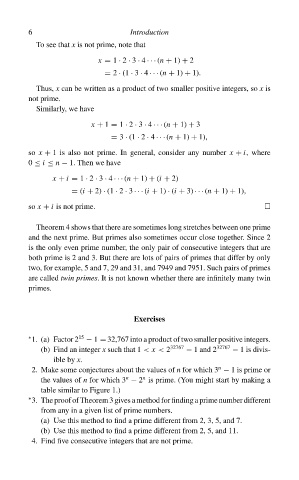
                                     To see that x is not prime, note that
                                                    x = 1 · 2 · 3 · 4 ··· (n + 1) + 2
                                                      = 2 · (1 · 3 · 4 ··· (n + 1) + 1).

                                     Thus, x can be written as a product of two smaller positive integers, so x is
                                   not prime.
                                     Similarly, we have
                                                   x + 1 = 1 · 2 · 3 · 4 ··· (n + 1) + 3
                                                        = 3 · (1 · 2 · 4 ··· (n + 1) + 1),

                                   so x + 1 is also not prime. In general, consider any number x + i, where
                                   0 ≤ i ≤ n − 1. Then we have

                                         x + i = 1 · 2 · 3 · 4 ··· (n + 1) + (i + 2)
                                              = (i + 2) · (1 · 2 · 3 ··· (i + 1) · (i + 3) ··· (n + 1) + 1),

                                   so x + i is not prime.

                                     Theorem 4 shows that there are sometimes long stretches between one prime
                                   and the next prime. But primes also sometimes occur close together. Since 2
                                   is the only even prime number, the only pair of consecutive integers that are
                                   both prime is 2 and 3. But there are lots of pairs of primes that differ by only
                                   two, for example, 5 and 7, 29 and 31, and 7949 and 7951. Such pairs of primes
                                   are called twin primes. It is not known whether there are infinitely many twin
                                   primes.


                                                              Exercises

                                   1. (a) Factor 2 − 1 = 32,767 into a product of two smaller positive integers.
                                   ∗           15
                                      (b) Find an integer x such that 1 < x < 2 32767  − 1 and 2 32767  − 1 is divis-
                                         ible by x.
                                                                                   n
                                   2. Make some conjectures about the values of n for which 3 − 1 is prime or
                                                                n
                                                           n
                                      the values of n for which 3 − 2 is prime. (You might start by making a
                                      table similar to Figure 1.)
                                   ∗
                                   3. The proof of Theorem 3 gives a method for finding a prime number different
                                      from any in a given list of prime numbers.
                                      (a) Use this method to find a prime different from 2, 3, 5, and 7.
                                      (b) Use this method to find a prime different from 2, 5, and 11.
                                   4. Find five consecutive integers that are not prime.

