


Page 220 - HOW TO PROVE IT: A Structured Approach, Second Edition
P. 220
P1: PIG/  P2: OYK/
                   0521861241c04  CB996/Velleman  October 20, 2005  2:54  0 521 86124 1  Char Count= 0


                                   206                        Relations
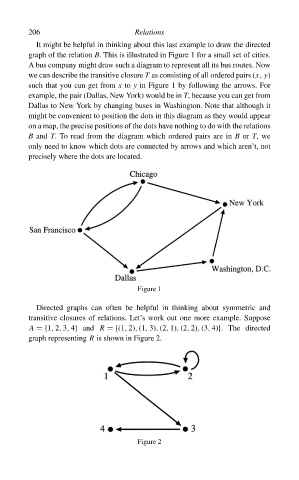
                                     It might be helpful in thinking about this last example to draw the directed
                                   graph of the relation B. This is illustrated in Figure 1 for a small set of cities.
                                   A bus company might draw such a diagram to represent all its bus routes. Now
                                   we can describe the transitive closure T as consisting of all ordered pairs (x, y)
                                   such that you can get from x to y in Figure 1 by following the arrows. For
                                   example, the pair (Dallas, New York) would be in T, because you can get from
                                   Dallas to New York by changing buses in Washington. Note that although it
                                   might be convenient to position the dots in this diagram as they would appear
                                   on a map, the precise positions of the dots have nothing to do with the relations
                                   B and T. To read from the diagram which ordered pairs are in B or T,we
                                   only need to know which dots are connected by arrows and which aren’t, not
                                   precisely where the dots are located.


                                                              Figure 1

                                     Directed graphs can often be helpful in thinking about symmetric and
                                   transitive closures of relations. Let’s work out one more example. Suppose
                                   A ={1, 2, 3, 4} and R ={(1, 2), (1, 3), (2, 1), (2, 2), (3, 4)}. The directed
                                   graph representing R is shown in Figure 2.


                                                              Figure 2

