


Page 247 - HOW TO PROVE IT: A Structured Approach, Second Edition
P. 247
P1: Oyk/
                   0521861241c05  CB996/Velleman  October 19, 2005  0:16  0 521 86124 1  Char Count= 0


                                                       Functions                       233
                                      2
                               f (2) = 2 − 3 · 2 + 1 =−1, so (g ◦ f )(2) = g( f (2)) = g(−1) = 1. In
                               general, for every n ∈ Z,
                                                                        2
                                                          2
                                   (g ◦ f )(n) = g( f (n)) = g(n − 3n + 1) = 2(n − 3n + 1) + 3
                                                2
                                            = 2n − 6n + 5.


                                                       Exercises

                              1. (a) Let A ={1, 2, 3}, B ={4}, and f ={(1, 4), (2, 4), (3, 4)}.Is f a
                             ∗
                                   function from A to B?
                                (b) Let A ={1}, B ={2, 3, 4}, and f ={(1, 2), (1, 3), (1, 4)}.Is f a
                                   function from A to B?
                                (c) Let C be the set of all cars registered in your state, and let S be the set of
                                   all finite sequences of letters and digits. Let L ={(c, s) ∈ C × S | the
                                   license plate number of the car c is s}.Is L a function from C to S?
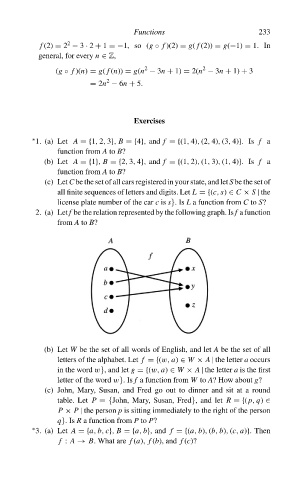
                              2. (a) Let f be the relation represented by the following graph. Is f a function
                                   from A to B?


                                (b) Let W be the set of all words of English, and let A be the set of all
                                   letters of the alphabet. Let f ={(w, a) ∈ W × A | the letter a occurs
                                   in the word w}, and let g ={(w, a) ∈ W × A | the letter a is the first
                                   letter of the word w}.Is f a function from W to A? How about g?
                                (c) John, Mary, Susan, and Fred go out to dinner and sit at a round
                                   table. Let P = {John, Mary, Susan, Fred}, and let R ={(p, q) ∈
                                    P × P | the person p is sitting immediately to the right of the person
                                   q}.Is R a function from P to P?
                              3. (a) Let A ={a, b, c}, B ={a, b}, and f ={(a, b), (b, b), (c, a)}. Then
                             ∗
                                    f : A → B. What are f (a), f (b), and f (c)?

