


Page 252 - HOW TO PROVE IT: A Structured Approach, Second Edition
P. 252
P1: Oyk/
                   0521861241c05  CB996/Velleman  October 19, 2005  0:16  0 521 86124 1  Char Count= 0


                                   238                        Functions
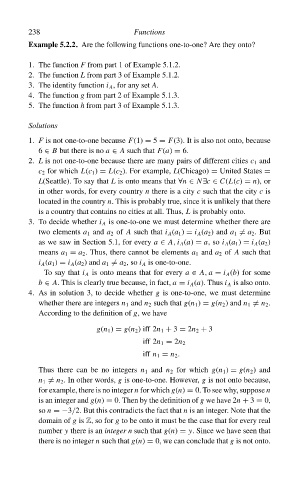
                                   Example 5.2.2. Are the following functions one-to-one? Are they onto?

                                   1. The function F from part 1 of Example 5.1.2.
                                   2. The function L from part 3 of Example 5.1.2.
                                   3. The identity function i A , for any set A.
                                   4. The function g from part 2 of Example 5.1.3.
                                   5. The function h from part 3 of Example 5.1.3.


                                   Solutions
                                   1. F is not one-to-one because F(1) = 5 = F(3). It is also not onto, because
                                     6 ∈ B but there is no a ∈ A such that F(a) = 6.
                                   2. L is not one-to-one because there are many pairs of different cities c 1 and
                                     c 2 for which L(c 1 ) = L(c 2 ). For example, L(Chicago) = United States =
                                     L(Seattle). To say that L is onto means that ∀n ∈ N∃c ∈ C(L(c) = n), or
                                     in other words, for every country n there is a city c such that the city c is
                                     located in the country n. This is probably true, since it is unlikely that there
                                     is a country that contains no cities at all. Thus, L is probably onto.
                                   3. To decide whether i A is one-to-one we must determine whether there are
                                     two elements a 1 and a 2 of A such that i A (a 1 ) = i A (a 2 ) and a 1  = a 2 . But
                                     as we saw in Section 5.1, for every a ∈ A, i A (a) = a,so i A (a 1 ) = i A (a 2 )
                                     means a 1 = a 2 . Thus, there cannot be elements a 1 and a 2 of A such that
                                     i A (a 1 ) = i A (a 2 ) and a 1  = a 2 ,so i A is one-to-one.
                                       To say that i A is onto means that for every a ∈ A, a = i A (b) for some
                                     b ∈ A. This is clearly true because, in fact, a = i A (a). Thus i A is also onto.
                                   4. As in solution 3, to decide whether g is one-to-one, we must determine
                                     whether there are integers n 1 and n 2 such that g(n 1 ) = g(n 2 ) and n 1  = n 2 .
                                     According to the definition of g,wehave

                                                    g(n 1 ) = g(n 2 )iff 2n 1 + 3 = 2n 2 + 3

                                                                iff 2n 1 = 2n 2
                                                                iff n 1 = n 2 .

                                     Thus there can be no integers n 1 and n 2 for which g(n 1 ) = g(n 2 ) and
                                     n 1  = n 2 . In other words, g is one-to-one. However, g is not onto because,
                                     for example, there is no integer n for which g(n) = 0. To see why, suppose n
                                     is an integer and g(n) = 0. Then by the definition of g we have 2n + 3 = 0,
                                     so n =−3/2. But this contradicts the fact that n is an integer. Note that the
                                     domain of g is Z,sofor g to be onto it must be the case that for every real
                                     number y there is an integer n such that g(n) = y. Since we have seen that
                                     there is no integer n such that g(n) = 0, we can conclude that g is not onto.

