


Page 272 - HOW TO PROVE IT: A Structured Approach, Second Edition
P. 272
P1: Oyk/
                   0521861241c05  CB996/Velleman  October 19, 2005  0:16  0 521 86124 1  Char Count= 0


                                   258                        Functions


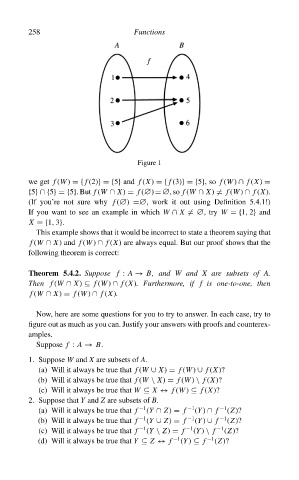
                                                              Figure 1

                                   we get f (W) ={ f (2)}={5} and f (X) ={ f (3)}={5},so f (W) ∩ f (X) =
                                   {5}∩{5}={5}. But f (W ∩ X) = f (∅) =∅,so f (W ∩ X)  = f (W) ∩ f (X).
                                   (If you’re not sure why f (∅) =∅, work it out using Definition 5.4.1!)
                                   If you want to see an example in which W ∩ X  = ∅, try W ={1, 2} and
                                   X ={1, 3}.
                                     This example shows that it would be incorrect to state a theorem saying that
                                   f (W ∩ X) and f (W) ∩ f (X) are always equal. But our proof shows that the
                                   following theorem is correct:

                                   Theorem 5.4.2. Suppose f : A → B, and W and X are subsets of A.
                                   Then f (W ∩ X) ⊆ f (W) ∩ f (X). Furthermore, if f is one-to-one, then
                                   f (W ∩ X) = f (W) ∩ f (X).


                                     Now, here are some questions for you to try to answer. In each case, try to
                                   figure out as much as you can. Justify your answers with proofs and counterex-
                                   amples.
                                     Suppose f : A → B.
                                   1. Suppose W and X are subsets of A.
                                     (a) Will it always be true that f (W ∪ X) = f (W) ∪ f (X)?
                                     (b) Will it always be true that f (W \ X) = f (W) \ f (X)?
                                     (c) Will it always be true that W ⊆ X ↔ f (W) ⊆ f (X)?
                                   2. Suppose that Y and Z are subsets of B.
                                     (a) Will it always be true that f  −1 (Y ∩ Z) = f  −1 (Y) ∩ f  −1 (Z)?
                                     (b) Will it always be true that f  −1 (Y ∪ Z) = f  −1 (Y) ∪ f  −1 (Z)?
                                     (c) Will it always be true that f  −1 (Y \ Z) = f  −1 (Y) \ f  −1 (Z)?
                                     (d) Will it always be true that Y ⊆ Z ↔ f  −1 (Y) ⊆ f  −1 (Z)?

