


Page 276 - HOW TO PROVE IT: A Structured Approach, Second Edition
P. 276
P1: Oyk/
                   0521861241c06  CB996/Velleman  October 20, 2005  1:8  0 521 86124 1  Char Count= 0


                                   262                  Mathematical Induction
                                   proof is to recognize that the left side of the equation in the goal is exactly the
                                   same as the left side of the second given, but with the extra term 2 n+1  added
                                   on. So let’s try adding 2 n+1  to both sides of the second given.
                                   This gives us

                                                   1
                                               0
                                                            n
                                             (2 + 2 +· · · + 2 ) + 2 n+1  = (2 n+1  − 1) + 2 n+1  ,
                                   or in other words,
                                                   1
                                               0
                                              2 + 2 +· · · + 2 n+1  = 2 · 2 n+1  − 1 = 2 n+2  − 1.
                                   This is the goal, so we are done!

                                   Solution

                                                                                 n
                                                                    0
                                                                        1
                                   Theorem. For every natural number n, 2 + 2 +· · · + 2 = 2 n+1  − 1.
                                   Proof. We use mathematical induction.
                                                                        1
                                                                0
                                     Base case: Setting n = 0, we get 2 = 1 = 2 − 1 as required.
                                     Induction step: Let n be an arbitrary natural number and suppose that
                                                 n
                                        1
                                    0
                                   2 + 2 +· · · + 2 = 2 n+1  − 1. Then
                                             0
                                                                               n
                                                  1
                                                                      1
                                                                  0
                                            2 + 2 +· · · + 2 n+1  = (2 + 2 +· · · + 2 ) + 2 n+1
                                                              = (2 n+1  − 1) + 2 n+1
                                                              = 2 · 2 n+1  − 1
                                                              = 2 n+2  − 1.
                                                                                         0    1
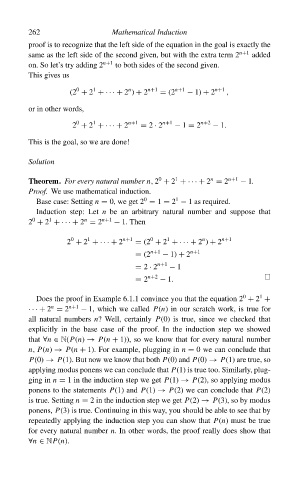
                                     Does the proof in Example 6.1.1 convince you that the equation 2 + 2 +
                                        n
                                   ··· + 2 = 2 n+1  − 1, which we called P(n) in our scratch work, is true for
                                   all natural numbers n? Well, certainly P(0) is true, since we checked that
                                   explicitly in the base case of the proof. In the induction step we showed
                                   that ∀n ∈ N(P(n) → P(n + 1)), so we know that for every natural number
                                   n, P(n) → P(n + 1). For example, plugging in n = 0 we can conclude that
                                   P(0) → P(1). But now we know that both P(0) and P(0) → P(1) are true, so
                                   applying modus ponens we can conclude that P(1) is true too. Similarly, plug-
                                   ging in n = 1 in the induction step we get P(1) → P(2), so applying modus
                                   ponens to the statements P(1) and P(1) → P(2) we can conclude that P(2)
                                   is true. Setting n = 2 in the induction step we get P(2) → P(3), so by modus
                                   ponens, P(3) is true. Continuing in this way, you should be able to see that by
                                   repeatedly applying the induction step you can show that P(n) must be true
                                   for every natural number n. In other words, the proof really does show that
                                   ∀n ∈ NP(n).

