


Page 383 - HOW TO PROVE IT: A Structured Approach, Second Edition
P. 383
P1: PIG/
                   0521861241apx01  CB996/Velleman  October 20, 2005  2:56  0 521 86124 1  Char Count= 0


                                         Appendix 1: Solutions to Selected Exercises   369
                                   one-to-one, onto function from I n to A i }. By inductive hypothesis, F i is

                                   finite and |F i |= n!. Now let F ={ f ∈ F | f (n + 1) = g(i)}. Define
                                                           i
                                   a function h : F i → F by the formula h( f ) = f ∪{(n + 1, g(i))}.

                                                     i
                                   It is not hard to check that h is one-to-one and onto, so F is

                                                                                       i
                                                                                    F and

                                             i                                       i
                                   finite and |F |=|F i |= n!. Finally, notice that F =∪ i∈I n+1


                                   ∀i ∈ I n+1 ∀ j ∈ I n+1 (i  = j → F ∩ F = ∅). It follows, by exercise
                                                            i   j
                                                            n+1

                                   19, that F is finite and |F|=  |F |= (n + 1) · n! = (n + 1)!.
                                                            i=1  i
                               (b) Hint: Define h : F → L by the formula h( f ) ={(a, b) ∈ A ×
                                   A | f  −1 (a) ≤ f  −1 (b)}. (You should check that this set is a total order on
                                   A.) To see that h is one-to-one, suppose that f ∈ F, g ∈ F, and f  = g.
                                   Let i be the smallest element of I n for which f (i)  = g(i). Now show
                                   that ( f (i), g(i)) ∈ h( f ) but ( f (i), g(i)) /∈ h(g), so h( f )  = h(g). To see
                                   that h is onto, suppose R is a total order on A. Define g : A → I n by the
                                   formula g(a) =|{x ∈ A | xRa}|. Show that ∀a ∈ A∀b ∈ A(aRb ↔
                                                                                   −1
                                   g(a) ≤ g(b)), and use this fact to show that g −1  ∈ F and h(g ) = R.
                               (c) 5! = 120.
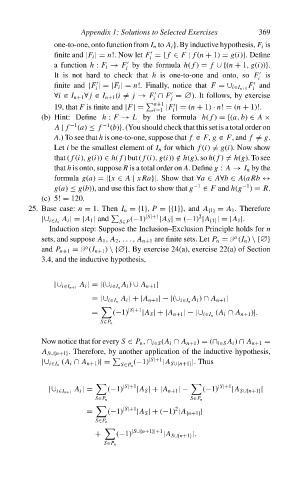
                            25. Base case: n = 1. Then I n ={1}, P ={{1}}, and A {1} = A 1 . Therefore
                                                          |S|+1        2
                                     A i |=|A 1 | and  (−1)  |A S |= (−1) |A {1} |=|A 1 |.
                               |∪ i∈I n            S∈P
                                 Induction step: Suppose the Inclusion–Exclusion Principle holds for n
                               sets, and suppose A 1 , A 2 ,..., A n+1 are finite sets. Let P n = P (I n ) \{∅}
                               and P n+1 = P (I n+1 ) \{∅}. By exercise 24(a), exercise 22(a) of Section
                               3.4, and the inductive hypothesis,
                                                    A i ) ∪ A n+1 |
                                   |∪ i∈I n+1  A i |=|(∪ i∈I n
                                                                      A i ) ∩ A n+1 |
                                            =|∪ i∈I n  A i |+|A n+1 |−|(∪ i∈I n
                                                     |S|+1
                                            =     (−1)   |A S |+|A n+1 |−|∪ i∈I n  (A i ∩ A n+1 )|.
                                              S∈P n
                               Now notice that for every S ∈ P n , ∩ i∈S (A i ∩ A n+1 ) = (∩ i∈S A i ) ∩ A n+1 =
                                A S∪{n+1} . Therefore, by another application of the inductive hypothesis,
                                                           |S|+1
                                    (A i ∩ A n+1 )|=   (−1)   |A S∪{n+1} |. Thus
                               |∪ i∈I n
                                                    S∈P n
                                                    |S|+1                   |S|+1
                                        A i |=  (−1)    |A S |+|A n+1 |−  (−1)  |A S∪{n+1} |
                                 |∪ i∈I n+1
                                             S∈P n                   S∈P n
                                                    |S|+1        2
                                           =    (−1)    |A S |+ (−1) |A {n+1} |
                                             S∈P n
                                                      |S∪{n+1}|+1
                                             +    (−1)        |A S∪{n+1} |.
                                               S∈P n

