


Page 91 - HOW TO PROVE IT: A Structured Approach, Second Edition
P. 91
P1: PIG/  P2: Oyk/
                   0521861241c02  CB996/Velleman  October 19, 2005  23:48  0 521 86124 1  Char Count= 0


                                                 More Operations on Sets                77
                            occurred inside the power set notation, so we wrote out the definition of power
                            set first. In statement 5, the power set notation occurred within both sides of
                            the notation for the intersection of two sets, so we started with the definition of
                            intersection. Similar considerations led us to use the definition of subset first,
                            rather than power set, in statement 2.
                              It is interesting to note that our answers for statements 4 and 5 in
                            Example 2.3.3 are equivalent. (You are asked to verify this in exercise 10.) As in
                            Section 1.4, it follows that for any sets A and B, P (A ∩ B) = P (A) ∩ P (B).
                            You are asked in exercise 11 to show that this equation is not true in general if
                            we change ∩ to ∪.
                              Consider once again the family of sets F ={C s | s ∈ S}, where S is the set
                            of all students and for each student s, C s is the set of all courses that s has taken.
                            If we wanted to know which courses had been taken by all students, we would
                            need to find those elements that all the sets in F have in common. The set of all
                            these common elements is called the intersection of the family F and is written
                            ∩F. Similarly, the union of the family F, written ∪F, is the set resulting from
                            throwing all the elements of all the sets in F together into one set. In this case,
                            ∪F would be the set of all courses that had been taken by any student.


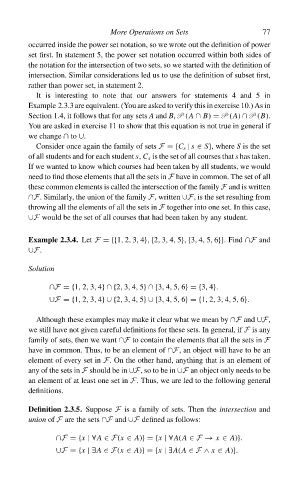
                            Example 2.3.4. Let F ={{1, 2, 3, 4}, {2, 3, 4, 5}, {3, 4, 5, 6}}. Find ∩F and
                            ∪F.

                            Solution

                                 ∩F ={1, 2, 3, 4}∩{2, 3, 4, 5}∩{3, 4, 5, 6}={3, 4}.
                                 ∪F ={1, 2, 3, 4}∪{2, 3, 4, 5}∪{3, 4, 5, 6}={1, 2, 3, 4, 5, 6}.


                              Although these examples may make it clear what we mean by ∩F and ∪F,
                            we still have not given careful definitions for these sets. In general, if F is any
                            family of sets, then we want ∩F to contain the elements that all the sets in F
                            have in common. Thus, to be an element of ∩F, an object will have to be an
                            element of every set in F. On the other hand, anything that is an element of
                            any of the sets in F should be in ∪F,sotobein ∪F an object only needs to be
                            an element of at least one set in F. Thus, we are led to the following general
                            definitions.

                            Definition 2.3.5. Suppose F is a family of sets. Then the intersection and
                            union of F are the sets ∩F and ∪F defined as follows:
                                   ∩F ={x |∀A ∈ F(x ∈ A)}={x |∀A(A ∈ F → x ∈ A)}.
                                   ∪F ={x |∃A ∈ F(x ∈ A)}={x |∃A(A ∈ F ∧ x ∈ A)}.

