


Page 94 - HOW TO PROVE IT: A Structured Approach, Second Edition
P. 94
P1: PIG/  P2: Oyk/
                   0521861241c02  CB996/Velleman  October 19, 2005  23:48  0 521 86124 1  Char Count= 0


                                   80                   Quantificational Logic
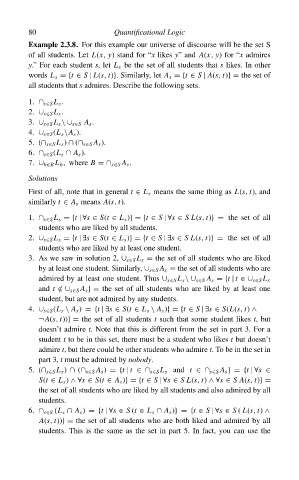
                                   Example 2.3.8. For this example our universe of discourse will be the set S
                                   of all students. Let L(x, y) stand for “x likes y” and A(x, y) for “x admires
                                   y.” For each student s, let L s be the set of all students that s likes. In other
                                   words L s ={t ∈ S | L(s, t)}. Similarly, let A s ={t ∈ S | A(s, t)}= the set of
                                   all students that s admires. Describe the following sets.

                                   1. ∩ s∈S L s .
                                   2. ∪ s∈S L s .
                                   3. ∪ s∈S L s \∪ s∈S A s .
                                   4. ∪ s∈S (L s \A s ).
                                   5. (∩ s∈S L s ) ∩ (∩ s∈S A s ).
                                   6. ∩ s∈S (L s ∩ A s ).
                                   7. ∪ b∈B L b , where B =∩ s∈S A s .

                                   Solutions
                                   First of all, note that in general t ∈ L s means the same thing as L(s, t), and
                                   similarly t ∈ A s means A(s, t).
                                   1. ∩ s∈S L s ={t |∀s ∈ S(t ∈ L s )}={t ∈ S |∀s ∈ SL(s, t)}= the set of all
                                     students who are liked by all students.
                                   2. ∪ s∈S L s ={t |∃s ∈ S(t ∈ L s )}={t ∈ S |∃s ∈ SL(s, t)}= the set of all
                                     students who are liked by at least one student.
                                   3. As we saw in solution 2, ∪ s∈S L s = the set of all students who are liked
                                     by at least one student. Similarly, ∪ s∈S A s = the set of all students who are
                                     admired by at least one student. Thus ∪ s∈S L s \∪ s∈S A s ={t | t ∈∪ s∈S L s
                                     and t /∈∪ s∈S A s }= the set of all students who are liked by at least one
                                     student, but are not admired by any students.
                                   4. ∪ s∈S (L s \ A s ) ={t |∃s ∈ S(t ∈ L s \ A s )}={t ∈ S |∃s ∈ S(L(s, t) ∧
                                     ¬A(s, t))}= the set of all students t such that some student likes t,but
                                     doesn’t admire t. Note that this is different from the set in part 3. For a
                                     student t to be in this set, there must be a student who likes t but doesn’t
                                     admire t, but there could be other students who admire t. To be in the set in
                                     part 3, t must be admired by nobody.
                                   5. (∩ s∈S L s ) ∩ (∩ s∈S A s ) ={t | t ∈∩ s∈S L s and t ∈∩ s∈S A s }={t |∀s ∈
                                     S(t ∈ L s ) ∧∀s ∈ S(t ∈ A s )}={t ∈ S |∀s ∈ SL(s, t) ∧∀s ∈ SA(s, t)}=
                                     the set of all students who are liked by all students and also admired by all
                                     students.
                                   6. ∩ s∈S (L s ∩ A s ) ={t |∀s ∈ S (t ∈ L s ∩ A s )}={t ∈ S |∀s ∈ S ( L(s, t) ∧
                                     A(s, t))}= the set of all students who are both liked and admired by all
                                     students. This is the same as the set in part 5. In fact, you can use the

