


Page 10 - DnD_BasicRules_2018
P. 10
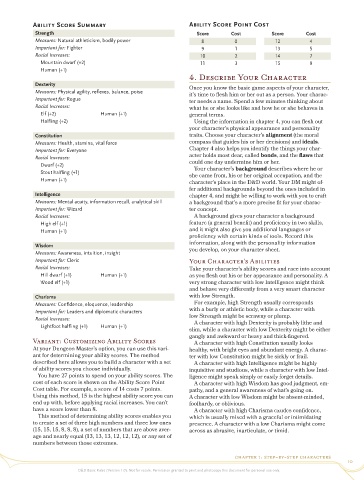
Ability Score Summary                              Ability Score Point Cost
             Strength                                            Score      Cost          Score      Cost
             Measures: Natural athleticism, bodily power           8          0            12         4
             Important for: Fighter                                9          1            13         5
             Racial Increases:                                    10          2            14         7
              Mountain dwarf (+2)                                 11          3            15         9
              Human (+1)
                                                               4. Describe Your Character
             Dexterity
                                                               Once you know the basic game aspects of your character,
             Measures: Physical agility, reflexes, balance, poise
                                                               it’s time to flesh him or her out as a person. Your charac-
             Important for: Rogue
                                                               ter needs a name. Spend a few minutes thinking about
             Racial Increases:                                 what he or she looks like and how he or she behaves in
              Elf (+2)            Human (+1)                   general terms.
              Halfling (+2)                                      Using the information in chapter 4, you can flesh out
                                                               your character’s physical appearance and personality
             Constitution                                      traits. Choose your character’s alignment (the moral
             Measures: Health, stamina, vital force            compass that guides his or her decisions) and ideals.
             Important for: Everyone                           Chapter 4 also helps you identify the things your char-
             Racial Increases:                                 acter holds most dear, called bonds, and the flaws that
              Dwarf (+2)                                       could one day undermine him or her.
              Stout halfling (+1)                                Your character’s background describes where he or
                                                               she came from, his or her original occupation, and the
              Human (+1)
                                                               character’s place in the D&D world. Your DM might of-
                                                               fer additional backgrounds beyond the ones included in
             Intelligence                                      chapter 4, and might be willing to work with you to craft
             Measures: Mental acuity, information recall, analytical skill  a background that’s a more precise fit for your charac-
             Important for: Wizard                             ter concept.
             Racial Increases:                                   A background gives your character a background
              High elf (+1)                                    feature (a general benefit) and proficiency in two skills,
              Human (+1)                                       and it might also give you additional languages or
                                                               proficiency with certain kinds of tools. Record this
             Wisdom                                            information, along with the personality information
                                                               you develop, on your character sheet.
             Measures: Awareness, intuition, insight
             Important for: Cleric                             Your Character’s Abilities
             Racial Increases:                                 Take your character’s ability scores and race into account
              Hill dwarf (+1)     Human (+1)                   as you flesh out his or her appearance and personality. A
              Wood elf (+1)                                    very strong character with low Intelligence might think
                                                               and behave very differently from a very smart character
             Charisma                                          with low Strength.
             Measures: Confidence, eloquence, leadership         For example, high Strength usually corresponds
             Important for: Leaders and diplomatic characters  with a burly or athletic body, while a character with
             Racial Increases:                                 low Strength might be scrawny or plump.
                                                                 A character with high Dexterity is probably lithe and
              Lightfoot halfling (+1)  Human (+1)
                                                               slim, while a character with low Dexterity might be either
                                                               gangly and awkward or heavy and thick-fingered.
            Variant: Customizing Ability Scores                  A character with high Constitution usually looks
            At your Dungeon Master’s option, you can use this vari-  healthy, with bright eyes and abundant energy. A charac-
            ant for determining your ability scores. The method   ter with low Constitution might be sickly or frail.
            described here allows you to build a character with a set     A character with high Intelligence might be highly
            of ability scores you choose individually.         inquisitive and studious, while a character with low Intel-
              You have 27 points to spend on your ability scores. The   ligence might speak simply or easily forget details.
            cost of each score is shown on the Ability Score Point     A character with high Wisdom has good judgment, em-
            Cost table. For example, a score of 14 costs 7 points.   pathy, and a general awareness of what’s going on.
            Using this method, 15 is the highest ability score you can   A character with low Wisdom might be absent-minded,
            end up with, before applying racial increases. You can’t   foolhardy, or oblivious.
            have a score lower than 8.                           A character with high Charisma exudes confidence,
              This method of determining ability scores enables you   which is usually mixed with a graceful or intimidating
            to create a set of three high numbers and three low ones   presence. A character with a low Charisma might come
            (15, 15, 15, 8, 8, 8), a set of numbers that are above aver-  across as abrasive, inarticulate, or timid.
            age and nearly equal (13, 13, 13, 12, 12, 12), or any set of
            numbers between those extremes.

                                                                              Chapter 1: Step-by-Step Characters
                                                                                                                  10 10
                           D&D Basic Rules (Version 1.0). Not for resale. Permission granted to print and photocopy this document for personal use only.

