


Page 166 - DnD_BasicRules_2018
P. 166
Party Size                                         opponents in an adventure as a guideline for how far the
                                                               party is likely to progress.
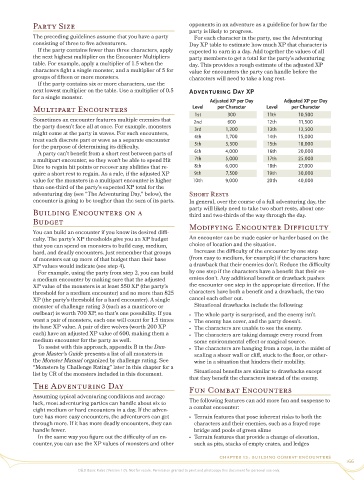
            The preceding guidelines assume that you have a party     For each character in the party, use the Adventuring
            consisting of three to five adventurers.           Day XP table to estimate how much XP that character is
              If the party contains fewer than three characters, apply   expected to earn in a day. Add together the values of all
            the next highest multiplier on the Encounter Multipliers   party members to get a total for the party’s adventuring
            table. For example, apply a multiplier of 1.5 when the   day. This provides a rough estimate of the adjusted XP
            characters fight a single monster, and a multiplier of 5 for   value for encounters the party can handle before the
            groups of fifteen or more monsters.                characters will need to take a long rest.
              If the party contains six or more characters, use the
            next lowest multiplier on the table. Use a multiplier of 0.5   Adventuring Day XP
            for a single monster.
                                                                      Adjusted XP per Day     Adjusted XP per Day
            Multipart Encounters                                Level   per Character   Level   per Character
                                                                 1st       300          11th      10,500
            Sometimes an encounter features multiple enemies that   2nd    600          12th      11,500
            the party doesn’t face all at once. For example, monsters
                                                                3rd        1,200        13th      13,500
            might come at the party in waves. For such encounters,
                                                                4th        1,700        14th      15,000
            treat each discrete part or wave as a separate encounter
                                                                5th        3,500        15th      18,000
            for the purpose of determining its difficulty.
                                                                6th        4,000        16th      20,000
              A party can’t benefit from a short rest between parts of
                                                                7th        5,000        17th      25,000
            a multipart encounter, so they won’t be able to spend Hit
            Dice to regain hit points or recover any abilities that re-  8th  6,000     18th      27,000
            quire a short rest to regain. As a rule, if the adjusted XP   9th  7,500    19th      30,000
            value for the monsters in a multipart encounter is higher   10th  9,000     20th      40,000
            than one-third of the party’s expected XP total for the
            adventuring day (see “The Adventuring Day,” below), the   Short Rests
            encounter is going to be tougher than the sum of its parts.  In general, over the course of a full adventuring day, the
            Building Encounters on a                           party will likely need to take two short rests, about one-
                                                               third and two-thirds of the way through the day.
            Budget
                                                               Modifying Encounter Difficulty
            You can build an encounter if you know its desired diffi-
            culty. The party’s XP thresholds give you an XP budget   An encounter can be made easier or harder based on the
            that you can spend on monsters to build easy, medium,   choice of location and the situation.
            hard, and deadly encounters. Just remember that groups     Increase the difficulty of the encounter by one step
            of monsters eat up more of that budget than their base   (from easy to medium, for example) if the characters have
            XP values would indicate (see step 4).             a drawback that their enemies don’t. Reduce the difficulty
              For example, using the party from step 2, you can build   by one step if the characters have a benefit that their en-
            a medium encounter by making sure that the adjusted   emies don’t. Any additional benefit or drawback pushes
            XP value of the monsters is at least 550 XP (the party’s   the encounter one step in the appropriate direction. If the
            threshold for a medium encounter) and no more than 825   characters have both a benefit and a drawback, the two
            XP (the party’s threshold for a hard encounter). A single   cancel each other out.
            monster of challenge rating 3 (such as a manticore or     Situational drawbacks include the following:
            owlbear) is worth 700 XP, so that’s one possibility. If you   •  The whole party is surprised, and the enemy isn’t.
            want a pair of monsters, each one will count for 1.5 times   •  The enemy has cover, and the party doesn’t.
            its base XP value. A pair of dire wolves (worth 200 XP   •  The characters are unable to see the enemy.
            each) have an adjusted XP value of 600, making them a   •  The characters are taking damage every round from
            medium encounter for the party as well.             some environmental effect or magical source.
              To assist with this approach, appendix B in the Dun-  •  The characters are hanging from a rope, in the midst of
            geon Master’s Guide presents a list of all monsters in   scaling a sheer wall or cliff, stuck to the floor, or other-
            the Monster Manual organized by challenge rating. See   wise in a situation that hinders their mobility.
            “Monsters by Challenge Rating” later in this chapter for a
                                                                 Situational benefits are similar to drawbacks except
            list by CR of the monsters included in this document.
                                                               that they benefit the characters instead of the enemy.
            The Adventuring Day
                                                               Fun Combat Encounters
            Assuming typical adventuring conditions and average
                                                               The following features can add more fun and suspense to
            luck, most adventuring parties can handle about six to
                                                               a combat encounter:
            eight medium or hard encounters in a day. If the adven-
            ture has more easy encounters, the adventurers can get   •  Terrain features that pose inherent risks to both the
            through more. If it has more deadly encounters, they can   characters and their enemies, such as a frayed rope
            handle fewer.                                       bridge and pools of green slime
              In the same way you figure out the difficulty of an en-  •  Terrain features that provide a change of elevation,
            counter, you can use the XP values of monsters and other   such as pits, stacks of empty crates, and ledges

                                                                         Chapter 13: Building Combat Encounters
                                                                                                                  166
                                                                                                                  166
                           D&D Basic Rules (Version 1.0). Not for resale. Permission granted to print and photocopy this document for personal use only.

