


Page 36 - DnD_BasicRules_2018
P. 36
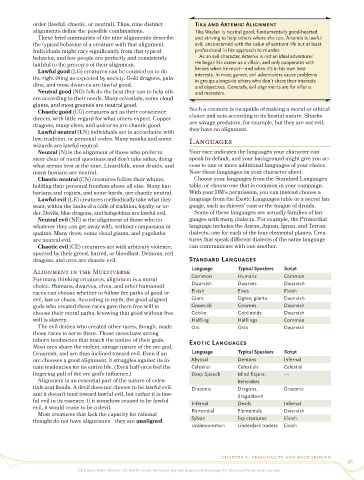
order (lawful, chaotic, or neutral). Thus, nine distinct   Tika and Artemis: Alignment
            alignments define the possible combinations.         Tika Waylan is neutral good, fundamentally good-hearted
              These brief summaries of the nine alignments describe   and striving to help others where she can. Artemis is lawful
            the typical behavior of a creature with that alignment.   evil, unconcerned with the value of sentient life but at least
            Individuals might vary significantly from that typical   professional in his approach to murder.
                                                                   As an evil character, Artemis is not an ideal adventurer.
            behavior, and few people are perfectly and consistently
                                                                 He began his career as a villain, and only cooperates with
            faithful to the precepts of their alignment.
                                                                 heroes when he must—and when it’s in his own best
              Lawful good (LG) creatures can be counted on to do
                                                                 interests. In most games, evil adventurers cause problems
            the right thing as expected by society. Gold dragons, pala-
                                                                 in groups alongside others who don’t share their interests
            dins, and most dwarves are lawful good.              and objectives. Generally, evil alignments are for villains
              Neutral good (NG) folk do the best they can to help oth-  and monsters.
            ers according to their needs. Many celestials, some cloud
            giants, and most gnomes are neutral good.
                                                               Such a creature is incapable of making a moral or ethical
              Chaotic good (CG) creatures act as their conscience
                                                               choice and acts according to its bestial nature. Sharks
            directs, with little regard for what others expect. Copper
                                                               are savage predators, for example, but they are not evil;
            dragons, many elves, and unicorns are chaotic good.
                                                               they have no alignment.
              Lawful neutral (LN) individuals act in accordance with
                                                               Languages
            law, tradition, or personal codes. Many monks and some
            wizards are lawful neutral.
              Neutral (N) is the alignment of those who prefer to   Your race indicates the languages your character can
            steer clear of moral questions and don’t take sides, doing   speak by default, and your background might give you ac-
            what seems best at the time. Lizardfolk, most druids, and   cess to one or more additional languages of your choice.
            many humans are neutral.                           Note these languages on your character sheet.
              Chaotic neutral (CN) creatures follow their whims,     Choose your languages from the Standard Languages
            holding their personal freedom above all else. Many bar-  table, or choose one that is common in your campaign.
            barians and rogues, and some bards, are chaotic neutral.  With your DM’s permission, you can instead choose a
              Lawful evil (LE) creatures methodically take what they   language from the Exotic Languages table or a secret lan-
            want, within the limits of a code of tradition, loyalty, or or-  guage, such as thieves’ cant or the tongue of druids.
            der. Devils, blue dragons, and hobgoblins are lawful evil.    Some of these languages are actually families of lan-
              Neutral evil (NE) is the alignment of those who do   guages with many dialects. For example, the Primordial
            whatever they can get away with, without compassion or   language includes the Auran, Aquan, Ignan, and Terran
            qualms. Many drow, some cloud giants, and yugoloths   dialects, one for each of the four elemental planes. Crea-
            are neutral evil.                                  tures that speak different dialects of the same language
              Chaotic evil (CE) creatures act with arbitrary violence,   can communicate with one another.
            spurred by their greed, hatred, or bloodlust. Demons, red
                                                               Standard Languages
            dragons, and orcs are chaotic evil.
            Alignment in the Multiverse                         Language       Typical Speakers  Script
                                                                Common         Humans         Common
            For many thinking creatures, alignment is a moral
                                                                Dwarvish       Dwarves        Dwarvish
            choice. Humans, dwarves, elves, and other humanoid
                                                                Elvish         Elves          Elvish
            races can choose whether to follow the paths of good or
                                                                Giant          Ogres, giants  Dwarvish
            evil, law or chaos. According to myth, the good-aligned
            gods who created these races gave them free will to   Gnomish      Gnomes         Dwarvish
            choose their moral paths, knowing that good without free   Goblin  Goblinoids     Dwarvish
            will is slavery.                                    Halfling       Halflings      Common
              The evil deities who created other races, though, made   Orc     Orcs           Dwarvish
            those races to serve them. Those races have strong
            inborn tendencies that match the nature of their gods.   Exotic Languages
            Most orcs share the violent, savage nature of the orc god,
                                                                Language       Typical Speakers  Script
            Gruumsh, and are thus inclined toward evil. Even if an
            orc chooses a good alignment, it struggles against its in-  Abyssal  Demons       Infernal
            nate tendencies for its entire life. (Even half-orcs feel the   Celestial  Celestials  Celestial
            lingering pull of the orc god’s influence.)         Deep Speech    Mind flayers,    —
              Alignment is an essential part of the nature of celes-           beholders
            tials and fiends. A devil does not choose to be lawful evil,   Draconic  Dragons,   Draconic
            and it doesn’t tend toward lawful evil, but rather it is law-
                                                                               dragonborn
            ful evil in its essence. If it somehow ceased to be lawful
                                                                Infernal       Devils         Infernal
            evil, it would cease to be a devil.
                                                                Primordial     Elementals     Dwarvish
              Most creatures that lack the capacity for rational
                                                                Sylvan         Fey creatures  Elvish
            thought do not have alignments—they are unaligned.
                                                                Undercommon    Underdark traders  Elvish


                                                                          Chapter 4: Personality and Background
                                                                                                                  36
                                                                                                                  36
                           D&D Basic Rules (Version 1.0). Not for resale. Permission granted to print and photocopy this document for personal use only.

