


Page 61 - DnD_BasicRules_2018
P. 61
applies more than once to the same roll, you still add it   to a DC, they compare the totals of their two checks. The
            only once and multiply or divide it only once.     participant with the higher check total wins the contest.
              By the same token, if a feature or effect allows you to   That character or monster either succeeds at the action
            multiply your proficiency bonus when making an ability   or prevents the other one from succeeding.
            check that wouldn’t normally benefit from your profi-    If the contest results in a tie, the situation remains the
            ciency bonus, you still don’t add the bonus to the check.   same as it was before the contest. Thus, one contestant
            For that check your proficiency bonus is 0, given the fact   might win the contest by default. If two characters tie in
            that multiplying 0 by any number is still 0. For instance, if   a contest to snatch a ring off the floor, neither character
            you lack proficiency in the History skill, you gain no ben-  grabs it. In a contest between a monster trying to open
            efit from a feature that lets you double your proficiency   a door and an adventurer trying to keep the door closed,
            bonus when you make Intelligence (History) checks.  a tie means that the door remains shut.
              In general, you don’t multiply your proficiency bonus for
            attack rolls or saving throws. If a feature or effect allows   Skills
            you to do so, these same rules apply.
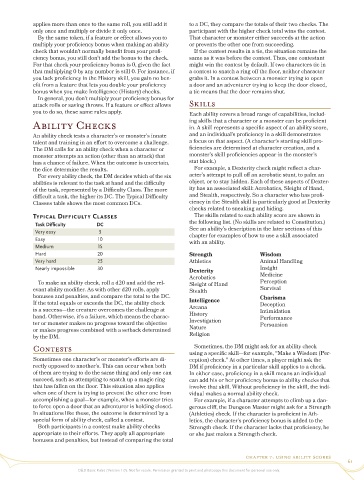
                                                               Each ability covers a broad range of capabilities, includ-
            Ability Checks                                     ing skills that a character or a monster can be proficient
                                                               in. A skill represents a specific aspect of an ability score,
            An ability check tests a character’s or monster’s innate   and an individual’s proficiency in a skill demonstrates
            talent and training in an effort to overcome a challenge.   a focus on that aspect. (A character’s starting skill pro-
            The DM calls for an ability check when a character or   ficiencies are determined at character creation, and a
            monster attempts an action (other than an attack) that   monster’s skill proficiencies appear in the monster’s
            has a chance of failure. When the outcome is uncertain,   stat block.)
            the dice determine the results.                      For example, a Dexterity check might reflect a char-
              For every ability check, the DM decides which of the six   acter’s attempt to pull off an acrobatic stunt, to palm an
            abilities is relevant to the task at hand and the difficulty   object, or to stay hidden. Each of these aspects of Dexter-
            of the task, represented by a Difficulty Class. The more   ity has an associated skill: Acrobatics, Sleight of Hand,
            difficult a task, the higher its DC. The Typical Difficulty   and Stealth, respectively. So a character who has profi-
            Classes table shows the most common DCs.           ciency in the Stealth skill is particularly good at Dexterity
                                                               checks related to sneaking and hiding.
            Typical Difficulty Classes                           The skills related to each ability score are shown in
             Task Difficulty     DC                            the following list. (No skills are related to Constitution.)
                                                               See an ability’s description in the later sections of this
             Very easy           5
             Easy                10                            chapter for examples of how to use a skill associated
                                                               with an ability.
             Medium              15
             Hard                20                            Strength               Wisdom
             Very hard           25                            Athletics              Animal Handling
             Nearly impossible   30                                                   Insight
                                                               Dexterity
                                                                                      Medicine
                                                               Acrobatics
              To make an ability check, roll a d20 and add the rel-  Sleight of Hand  Perception
            evant ability modifier. As with other d20 rolls, apply   Stealth          Survival
            bonuses and penalties, and compare the total to the DC.                   Charisma
                                                               Intelligence
            If the total equals or exceeds the DC, the ability check                  Deception
                                                               Arcana
            is a success—the creature overcomes the challenge at                      Intimidation
                                                               History
            hand. Otherwise, it’s a failure, which means the charac-                  Performance
                                                               Investigation
            ter or monster makes no progress toward the objective                     Persuasion
                                                               Nature
            or makes progress combined with a setback determined
                                                               Religion
            by the DM.
            Contests                                             Sometimes, the DM might ask for an ability check
                                                               using a specific skill—for example, “Make a Wisdom (Per-
            Sometimes one character’s or monster’s efforts are di-  ception) check.” At other times, a player might ask the
            rectly opposed to another’s. This can occur when both   DM if proficiency in a particular skill applies to a check.
            of them are trying to do the same thing and only one can   In either case, proficiency in a skill means an individual
            succeed, such as attempting to snatch up a magic ring   can add his or her proficiency bonus to ability checks that
            that has fallen on the floor. This situation also applies   involve that skill. Without proficiency in the skill, the indi-
            when one of them is trying to prevent the other one from   vidual makes a normal ability check.
            accomplishing a goal—for example, when a monster tries     For example, if a character attempts to climb up a dan-
            to force open a door that an adventurer is holding closed.   gerous cliff, the Dungeon Master might ask for a Strength
            In situations like these, the outcome is determined by a   (Athletics) check. If the character is proficient in Ath-
            special form of ability check, called a contest.   letics, the character’s proficiency bonus is added to the
              Both participants in a contest make ability checks   Strength check. If the character lacks that proficiency, he
            appropriate to their efforts. They apply all appropriate   or she just makes a Strength check.
            bonuses and penalties, but instead of comparing the total


                                                                                  Chapter 7: Using Ability Scores
                                                                                                                  61 61
                           D&D Basic Rules (Version 1.0). Not for resale. Permission granted to print and photocopy this document for personal use only.

