


Page 67 - DnD_BasicRules_2018
P. 67
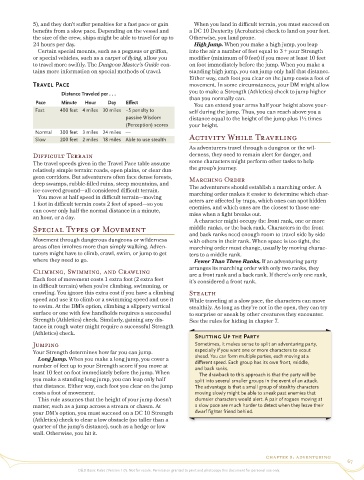
5), and they don’t suffer penalties for a fast pace or gain     When you land in difficult terrain, you must succeed on
            benefits from a slow pace. Depending on the vessel and   a DC 10 Dexterity (Acrobatics) check to land on your feet.
            the size of the crew, ships might be able to travel for up to   Otherwise, you land prone.
            24 hours per day.                                    High Jump. When you make a high jump, you leap
              Certain special mounts, such as a pegasus or griffon,   into the air a number of feet equal to 3 + your Strength
            or special vehicles, such as a carpet of flying, allow you   modifier (minimum of 0 feet) if you move at least 10 feet
            to travel more swiftly. The Dungeon Master’s Guide con-  on foot immediately before the jump. When you make a
            tains more information on special methods of travel.  standing high jump, you can jump only half that distance.
                                                               Either way, each foot you clear on the jump costs a foot of
            Travel Pace                                        movement. In some circumstances, your DM might allow
                      Distance Traveled per . . .              you to make a Strength (Athletics) check to jump higher
                                                               than you normally can.
             Pace    Minute  Hour   Day   Effect
                                                                 You can extend your arms half your height above your-
             Fast    400 feet 4 miles 30 miles −5 penalty to
                                                               self during the jump. Thus, you can reach above you a
                                          passive Wisdom       distance equal to the height of the jump plus 1½ times
                                          (Perception) scores  your height.
             Normal  300 feet 3 miles 24 miles —
             Slow    200 feet 2 miles 18 miles Able to use stealth  Activity While Traveling
                                                               As adventurers travel through a dungeon or the wil-
            Difficult Terrain                                  derness, they need to remain alert for danger, and
                                                               some characters might perform other tasks to help
            The travel speeds given in the Travel Pace table assume
                                                               the group’s journey.
            relatively simple terrain: roads, open plains, or clear dun-
            geon corridors. But adventurers often face dense forests,   Marching Order
            deep swamps, rubble-filled ruins, steep mountains, and
                                                               The adventurers should establish a marching order. A
            ice-covered ground—all considered difficult terrain.
                                                               marching order makes it easier to determine which char-
              You move at half speed in difficult terrain—moving
                                                               acters are affected by traps, which ones can spot hidden
            1 foot in difficult terrain costs 2 feet of speed—so you
                                                               enemies, and which ones are the closest to those ene-
            can cover only half the normal distance in a minute,
                                                               mies when a fight breaks out.
            an hour, or a day.
                                                                 A character might occupy the front rank, one or more
            Special Types of Movement                          middle ranks, or the back rank. Characters in the front
                                                               and back ranks need enough room to travel side by side
            Movement through dangerous dungeons or wilderness   with others in their rank. When space is too tight, the
            areas often involves more than simply walking. Adven-  marching order must change, usually by moving charac-
            turers might have to climb, crawl, swim, or jump to get   ters to a middle rank.
            where they need to go.                               Fewer Than Three Ranks. If an adventuring party
            Climbing, Swimming, and Crawling                   arranges its marching order with only two ranks, they
                                                               are a front rank and a back rank. If there’s only one rank,
            Each foot of movement costs 1 extra foot (2 extra feet
                                                               it’s considered a front rank.
            in difficult terrain) when you’re climbing, swimming, or
            crawling. You ignore this extra cost if you have a climbing   Stealth
            speed and use it to climb or a swimming speed and use it   While traveling at a slow pace, the characters can move
            to swim. At the DM’s option, climbing a slippery vertical   stealthily. As long as they’re not in the open, they can try
            surface or one with few handholds requires a successful   to surprise or sneak by other creatures they encounter.
            Strength (Athletics) check. Similarly, gaining any dis-  See the rules for hiding in chapter 7.
            tance in rough water might require a successful Strength
            (Athletics) check.
                                                                 Splitting Up the Party
            Jumping                                              Sometimes, it makes sense to split an adventuring party,
                                                                 especially if you want one or more characters to scout
            Your Strength determines how far you can jump.
                                                                 ahead. You can form multiple parties, each moving at a
              Long Jump. When you make a long jump, you cover a
                                                                 different speed. Each group has its own front, middle,
            number of feet up to your Strength score if you move at
                                                                 and back ranks.
            least 10 feet on foot immediately before the jump. When     The drawback to this approach is that the party will be
            you make a standing long jump, you can leap only half   split into several smaller groups in the event of an attack.
            that distance. Either way, each foot you clear on the jump   The advantage is that a small group of stealthy characters
            costs a foot of movement.                            moving slowly might be able to sneak past enemies that
              This rule assumes that the height of your jump doesn’t   clumsier characters would alert. A pair of rogues moving at
            matter, such as a jump across a stream or chasm. At   a slow pace are much harder to detect when they leave their
                                                                 dwarf fighter friend behind.
            your DM’s option, you must succeed on a DC 10 Strength
            (Athletics) check to clear a low obstacle (no taller than a
            quarter of the jump’s distance), such as a hedge or low
            wall. Otherwise, you hit it.


                                                                                        Chapter 8: Adventuring
                                                                                                                  67
                                                                                                                  67
                           D&D Basic Rules (Version 1.0). Not for resale. Permission granted to print and photocopy this document for personal use only.

