


Page 18 - Electrostatics 11
P. 18
Grade 11                                                                              © GC Shiba
        Thus, Electric intensity is equal to negative of electric potential gradient. Direction

        of E is along which electric potential gradient decreases.


        Equipotential surface:


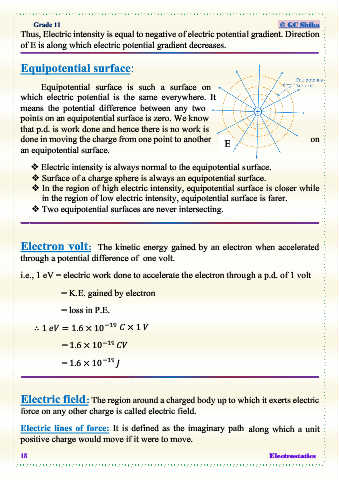
               Equipotential  surface  is  such  a  surface  on
        which  electric  potential  is  the  same  everywhere.  It

        means  the  potential  difference  between  any  two
        points on an equipotential surface is zero. We know
        that p.d. is work done and hence there is no work is

        done in moving the charge from one point to another                                                   on
        an equipotential surface.                                              E


            ❖ Electric intensity is always normal to the equipotential surface.
            ❖ Surface of a charge sphere is always an equipotential surface.
            ❖ In the region of high electric intensity, equipotential surface is closer while
               in the region of low electric intensity, equipotential surface is farer.

            ❖ Two equipotential surfaces are never intersecting.


        Electron volt:  The kinetic energy gained by an electron when accelerated
        through a potential difference of  one volt.


        i.e., 1 eV = electric work done to accelerate the electron through a p.d. of 1 volt


                       = K.E. gained by electron


                       = loss in P.E.


              ∴ 1      = 1.6 × 10     −19     × 1

                       = 1.6 × 10    −19


                       = 1.6 × 10    −19


        Electric field: The region around a charged body up to which it exerts electric
        force on any other charge is called electric field.


        Electric lines of force: It is defined as the imaginary path along which a unit
        positive charge would move if it were to move.


        18                                                                                      Electrostatics

