


Page 25 - Electrostatics 11
P. 25
Grade 11                                                                              © GC Shiba
           ☻ State and explain Gauss law in electrostatics. Use it to find the

               electric field intensity due to a line charge.


        4) Electric intensity due to linear distribution of charge (a thin

            straight charged wire or rod)

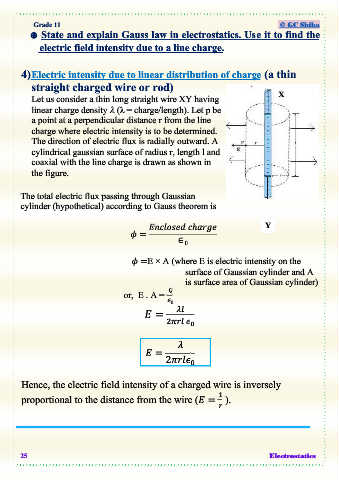
            Let us consider a thin long straight wire XY having                                    X
            linear charge density    (λ = charge/length). Let p be
            a point at a perpendicular distance r from the line

            charge where electric intensity is to be determined.
            The direction of electric flux is radially outward. A
            cylindrical gaussian surface of radius r, length l and
            coaxial with the line charge is drawn as shown in

            the figure.


        The total electric flux passing through Gaussian
        cylinder (hypothetical) according to Gauss theorem is


                                                                        ℎ                     Y
                                                   =
                                                               ∈ 0

                                                   =E × A (where E is electric intensity on the
                                                                  surface of Gaussian cylinder and A

                                                                  is surface area of Gaussian cylinder)

                                            or,  E . A =
                                                              0

                                                      =
                                                           2          0


                                                       =
                                                           2         0


        Hence, the electric field intensity of a charged wire is inversely

                                                                             1
        proportional to the distance from the wire (   =  ).


        25                                                                                      Electrostatics

