


Page 45 - PWR UP TG3 SAINS
P. 45
Sains Tingkatan 3 Bab 2
(i) Proses dalam Persamaan 1 terganggu kerana kecacatan bentuk sel-sel darah merah. Nyatakan
kesannya. TP3
The process in Equation 1 is disrupted due to the defect of red blood cells. State the e ect.
Kurang oksigen yang diangkut ke sel-sel badan
Less oxygen is transported to the body cells
(ii) Di manakah Persamaan 2 berlaku? TP2
Where does Equation 2 occur?
Dalam sel badan
In body cells
(iii) Apakah yang berlaku kepada oksigen dalam Persamaan 2?
What happen to the oxygen in Equation 2? TP4
Oksigen meresap ke dalam sel badan dan digunakan dalam respirasi sel untuk membebaskan
tenaga.
Oxygen di uses into the body cells and used in cell respiration to release energy.
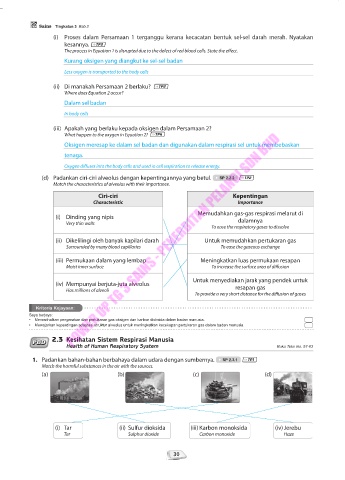
(d) Padankan ciri-ciri alveolus dengan kepentingannya yang betul. SP 2.2.2 TP2
Match the characteristics of alveolus with their importance.
Ciri-ciri Kepentingan
Characteristic Importance
Memudahkan gas-gas respirasi melarut di
(i) Dinding yang nipis
Very thin walls dalamnya
To ease the respiratory gases to dissolve
(ii) Dikelilingi oleh banyak kapilari darah Untuk memudahkan pertukaran gas
Surrounded by many blood capillaries To ease the gaseous exchange
(iii) Permukaan dalam yang lembap Meningkatkan luas permukaan resapan
Moist inner surface To increase the surface area of di usion
Untuk menyediakan jarak yang pendek untuk
(iv) Mempunyai berjuta-juta alveolus
Has millions of alveoli resapan gas
To provide a very short distance for the di usion of gases
Kriteria Kejayaan: .............................................................................................
Saya berjaya:
• Memerihalkan pengerakan dan pertukaran gas oksigen dan karbon dioksida dalam badan manusia.
• Mewajarkan kepentingan adaptasi struktur alveolus untuk meningkatkan kecekapan pertukaran gas dalam badan manusia.
PBD
PBD
PBD
PBD
PBD
PBD
PBD
PBD
PBD
PBD
PBD
PBD
PBD
PBD
PBD
PBD
PBD
PBD
PBD
PBD
PBD
PBD
PBD
PBD
PBD
PBD
PBD
PBD
PBD
PBD
PBD
PBD
PBD
PBD
PBD
PBD
PBD
PBD
PBD
PBD
PBD
PBD
PBD
PBD
PBD
PBD
PBD
PBD
PBD
PBD
PBD
PBD
PBD
PBD
PBD
PBD
PBD
PBD
PBD
PBD
PBD
PBD
PBD
PBD
PBD
PBD
PBD
PBD
PBD
PBD
PBD
PBD
PBD
PBD
PBD
PBD
PBD
PBD
PBD
PBD
PBD
PBD
PBD
PBD
PBD
PBD
PBD
PBD
PBD
PBD
PBD
PBD
PBD
PBD
PBD
PBD
PBD
PBD
PBD
PBD
PBD
PBD
PBD
PBD
PBD
PBD
PBD
PBD
PBD
PBD
PBD
PBD
PBD
PBD
PBD
PBD
PBD
PBD
PBD
PBD
PBD
PBD
PBD
PBD
PBD
PBD
PBD
PBD
PBD
PBD
PBD
PBD
PBD
PBD
PBD
PBD
PBD
PBD
PBD
PBD
PBD
PBD
PBD
PBD
PBD
PBD
PBD
PBD
PBD
PBD 2.3 Kesihatan Sistem Respirasi Manusia
PBD
PBD
PBD
PBD
PBD
PBD
PBD
PBD
PBD
PBD
PBD
PBD
PBD
PBD
PBD
PBD
PBD
PBD
PBD
PBD
PBD
PBD
PBD
PBD
PBD
PBD
PBD
PBD
PBD
PBD
PBD
PBD
PBD
PBD
PBD
PBD
PBD
PBD
PBD
PBD
PBD
PBD
PBD
PBD
PBD
PBD
PBD
PBD
PBD
PBD
PBD
PBD
PBD
PBD
PBD
PBD
PBD
PBD
PBD
PBD
PBD
PBD
PBD
PBD
PBD
PBD
PBD
PBD
PBD
PBD
PBD
PBD
PBD
PBD
PBD
PBD
PBD
PBD
PBD
PBD
PBD
PBD
PBD
PBD
PBD
PBD
PBD
PBD
PBD
PBD
PBD
PBD
PBD
PBD
PBD
PBD
PBD
PBD
PBD
PBD
PBD
PBD
PBD
PBD
PBD
PBD
PBD
PBD
PBD
PBD
PBD
PBD
PBD
PBD
PBD
PBD
PBD
PBD
PBD
PBD
PBD
PBD
PBD
PBD
PBD
PBD
PBD
PBD
PBD
PBD
PBD
PBD
PBD
PBD
PBD
PBD
PBD
Health of Human Respiratory System Buku Teks ms. 57-63
1. Padankan bahan-bahan berbahaya dalam udara dengan sumbernya. SP 2.3.1 TP1
Match the harmful substances in the air with the sources.
(a) (b) (c) (d)
(i) Tar (ii) Sulfur dioksida (iii) Karbon monoksida (iv) Jerebu
Tar Sulphur dioxide Carbon monoxide Haze
30
02 Power Up SC Tg3_p24-41.indd 30 9/28/20 9:59 AM

