


Page 64 - PRE-U STPM BIOLOGY TERM 1
P. 64
Biology Term 1  STPM  Chapter 2 Structure of Cells and Organelles
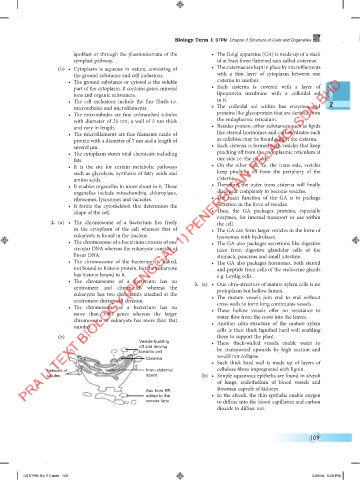
                         apoblast or through the plasmodesmata of the   •  The Golgi apparatus (GA) is made up of a stack
                         symplast pathway.                               of at least three flattened sacs called cisternae.
                     (b)   •  Cytoplasm  is  aqueous  in  nature,  consisting  of   •  The cisternae are kept in place by microfilaments
                         the ground substance and cell inclusions.       with a thin layer of cytoplasm between one
                        •   The ground substance or cytosol is the soluble   cisterna to another.
                         part of the cytoplasm. It contains gases, mineral   •  Each  cisterna  is  covered  with  a  layer  of
                         ions and organic substances.                    lipoprotein menbrane with a colloidal sol
                        •   The  cell  inclusions  include  the  fine  fibrils  i.e.   in it.                 2
                         microtubules and microfilaments.              •  The  colloidal  sol  within  has  enzymes  and
                        •   The microtubules are fine unbranched tubules   proteins like glycoprotein that are derived from
                         with diameter of 25 nm, a wall of 5 nm thick    the endoplasmic reticulum.
                         and vary in length.                           •  Besides protein, other substances such as lipids
                        •   The microfilaments are fine filaments made of   like steroid hormomes and carbohydrates such
                         protein with a diameter of 7 nm and a length of   as cellulose may be found within the cisterna.
                         several μm.                                   •  Each cisterna is formed with vesicles that keep
                        •   The cytoplasm stores vital chemicals including   pinching off from the endoplasmic reticulum at
                         fats.                                           one side i.e. the cis side.
                        •   It  is  the  site  for  certain  metabolic  pathways   •  On  the  other  side,  i.e.  the  trans  side,  vesicles
                         such as glycolysis, synthesis of fatty acids and   keep pinching off from the periphery of the
                         amino acids.                                    cisterna.
                        •   It enables organelles to move about in it. These   •  Therefore,  the  outer  trans  cisterna  will  finally
                         organelles include mitochondria, chloroplasts,   disappear completely to become vesicles.
                         ribosomes, lysosomes and vacuoles.            •  The  main  function  of  the  GA  is  to  package
                        •   It  forms  the  cytoskeleton  that  determines  the   secretion in the form of vesicles.
                         shape of the cell.                            •  Thus,  the  GA  packages  proteins,  especially
                                                                         enzymes, for internal transport or use within
                  2.  (a)  •  The  chromosome  of  a  bacterium  lies  freely   the cell.
                         in the cytoplasm of the cell whereas that of   •  The GA can form larger vesicles in the form of
                         eukaryote is found in the nucleus.              lysosomes with hydrolases.
                        •  The chromosome of a bacterium consists of one   •  The GA also packages secretions like digestive
                         circular DNA whereas the eukaryote consists of   juice from digestive glandular cells of the
                         linear DNA.                                     stomach, pancreas and small intestine.
                        •  The  chromosome  of  the  bacterium  is  naked,   •  The GA also packages hormones, both steroid
                         not bound to histone protein, but the eukaryote   and peptide from cells of the endocrine glands
                         has histone bound to it.                        e.g. Leydig cells.
                        •  The  chromosome  of  a  bacterium  has  no     3.  (a)   •  One ultra-structure of mature xylem cells is no
                         centromere and chromatids whereas the           protoplasm but hollow lumen.
                         eukaryote has two chromatids attached at the           •  The  mature  vessels  join  end  to  end  without
                         centromere during cell division.
                        •  The  chromosome  of  a  bacterium  has  no    cross walls to form long continuous vessels.
                         more than 3500 genes whereas the larger           •  These  hollow  vessels  offer  no  resistance  to
                                                                         water flow from the roots into the leaves.
                         chromosome of eukaryote has more than that           •  Another  ultra-structure  of  the  mature  xylem
                         number.
                                                                         cells is their thick lignified hard wall enabling
                    (b)                                                  them to support the plant.
                                               Vesicle budding           •  These  thick-walled  vessels  enable  water  to
                                               off and moving            be transported upwards by high suction and
                                               towards cell
                                                                         would not collapse.
                                                 Cisterna
                                                                        •  Such  thick  hard  wall  is  made  up  of  layers  of
                Network of                       Inter–cisternal         cellulose fibres impregnated with lignin.
                tubules                          space               (b)  •  Simple squamous epithelia are found in alveoli
                                                                         of lungs, endothelium of blood vessels and
                                                                         Bowman capsule of kidneys.
                                                 Sac from ER
                                                 added to the           •  In the alveoli, the thin epithelia enable oxygen
                                                 convex face             to diffuse into the blood capillaries and carbon
                                                                         dioxide to diffuse out.


                                                                                                        109


         02[STPM Bio T1].indd   109                                                                     3/29/18   5:08 PM

