


Page 3 - Amali Proses Sains T1 (EG)
P. 3
Keistimewaan Amali Proses Sains
Tingkatan 1–3
KANDUNGAN
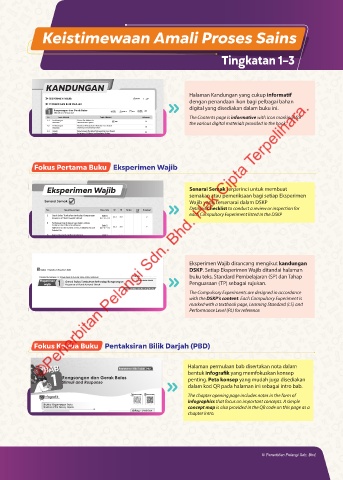
Halaman Kandungan yang cukup informatif
EKSPERIMEN WAJIB Simulasi 1 - 27 dengan penandaan ikon bagi pelbagai bahan
PENTAKSIRAN BILIK DARJAH
BAB Rangsangan dan Gerak Balas digital yang disediakan dalam buku ini.
1 Stimuli and Response Konsep Model 3D Video Nota 28
Peta
Ekstra
No. Jenis Aktiviti Tajuk Aktiviti Halaman The Contents page is informative with icon markings for
1.1 Perbincangan Sistem Saraf Manusia Video 29
Discussion Human Nervous System the various digital materials provided in the book.
1.2 Perbincangan Tindakan Terkawal dan Tindakan Luar Kawal 30
Discussion Voluntary and Involuntary Actions
1.3 Inkuiri Kepentingan Tindakan Terkawal dan Luar Kawal 31
Enquiry Importance of Voluntary and Involuntary Actions
1.4 Perbincangan Struktur dan Fungsi Mata Manusia Simulasi 33
Discussion Structure and Functions of the Human Eye
1.5 Perbincangan Struktur dan Fungsi Telinga Manusia 35
Discussion Structure and Functions of the Human Ear Video
1.6 Perbincangan Struktur Hidung 37
Discussion Structure of the Nose
1.7 Perbincangan Deria Sentuhan dan Struktur Kulit Manusia 38
Discussion Sense of Touch and the Structure of the Human Skin
1.8 Inkuiri Kepekaan Kulit pada Bahagian Badan yang berlainan terhadap Rangsangan 39
Enquiry Sensitivity of the Skin at Different Parts of the Body towards Stimuli
Struktur Lidah dan Kepekaannya terhadap Rasa
Inkuiri
1.9
41
Fokus Pertama Buku Eksperimen Wajib
Carta Mengajar
Enquiry
Structure of the Tongue and their Sensitivity towards Stimuli
1.10
Menghubungkaitkan Deria Rasa dengan Deria Bau
Inkuiri
Enquiry Relating the Sense of Taste with the Sense of Smell 43
1.11 Inkuiri Ilusi Optik 44
Enquiry Optical Illusion
1.12 Inkuiri Bintik Buta 45
Enquiry Blind Spot
1.13 Inkuiri Rabun Jauh, Rabun Dekat dan Cara Membetulkannya 46
Short-sightedness, Long-Sightedness and Ways to Correct Them
Enquiry
Eksperimen Wajib 48 Senarai Semak terperinci untuk membuat
Perbincangan
1.14
Kecacatan Pendengaran dan Cara Membetulkannya
Defects of Hearing and Ways to Correct Them
Discussion
1.15 Perbincangan Rangsangan dan Gerak Balas dalam Tumbuhan 49 semakan atau pemeriksaan bagi setiap Eksperimen
Discussion Stimuli and Responses in Plants
1.16
Senarai Semak Penglihatan Stereoskopik dan Monokular 50 Wajib yang tersenarai dalam DSKP
Perbincangan
Stereoscopic and Monocular Visions
Discussion
1.17 Perbincangan Pendengaran Haiwan Lain 51
Discussion Hearing in Other Animals Detailed Checklist to conduct a review or inspection for
No. Perbincangan Tajuk Eksperimen Deria Lain dalam Haiwan Buku Teks SP TP Tarikh Halaman
1.18
Discussion Other Sense in Animals 52 each Compulsory Experiment listed in the DSKP
1 Gerak Balas Tumbuhan terhadap Rangsangan Praktis Bab 1
Jawapan
Praktis Sumatif Praktis Ekstra Sumatif Praktis Sumatif Cabaran Interaktif 1 (ms 30 – 35) 1.3.3 1–2 53 2
Response of Plants towards Stimuli
KBAT
2 Perbezaan Kandungan Gas dalam Udara
Sedutan dan Udara Hembusan Bab 2
Difference in the Content of Gas in Inhaled Air and (ms 46 – 53) 2.1.2 1–2 6
Exhaled Air
3 Kesan Merokok terhadap Peparu Bab 2 1–2,
Effects of Smoking on the Lungs (ms 57 – 63) 2.3.2 4 10
4 Faktor yang Mempengaruhi Kadar Denyutan
Nadi Bab 3 3.2.3 1–2 13
Factors Affecting the Pulse Rate iii (ms 83 – 95)
5 Faktor-faktor yang Mempengaruhi Kadar
Transpirasi Bab 3 3.4.2 1–2 15
Factors Affecting the Rate of Transpiration (ms 102 – 112)
6 Perbandingan antara Tindak Balas Endotermik
dan Eksotermik Bab 5 Eksperimen Wajib dirancang mengikut kandungan
Comparison between Endothermic and Exothermic (ms 148 – 154) 5.1.2 1–2 22
Reactions
Sains Tingkatan 3 Eksperimen Wajib DSKP. Setiap Eksperimen Wajib ditandai halaman
7 Membina Transformer Injak Naik dan Bab 6 6.2.1,
Injak Turun
Standard Kandungan 1.3 Rangsangan dan gerak balas dalam tumbuhan (ms 177 – 183) 6.2.2 1–3 Tarikh: 25 buku teks, Standard Pembelajaran (SP) dan Tahap
Building Step-Up and Step-Down Transformers
wajib 1 Gerak Balas Tumbuhan terhadap Rangsangan Penguasaan (TP) sebagai rujukan.
Eksperimen Pendekatan inkuiri
Response of Plants towards Stimuli
Buku Teks Bab 1 ms 30 – 35 SP1.3.3
Mengkaji dan mengenal pasti rangsangan yang dikesan oleh tumbuhan dan gerak balas tumbuhan The Compulsory Experiments are designed in accordance
Tujuan
Aim terhadap rangsangan itu
To study and identify the stimuli detected by the plants and the response of plants towards the stimuli with the DSKP’s content. Each Compulsory Experiment is
Penyataan Bagaimanakah tumbuhan bergerak balas terhadap rangsangan cahaya, air, graviti dan sentuhan? marked with a textbook page, Learning Standard (LS) and
masalah How do plants respond towards light, water, gravity and touch stimuli?
Problem statement
Hipotesis Pucuk tumbuh ke arah light cahaya , manakala akar tumbuh ke arah and air gravity dan graviti . Performance Level (PL) for reference.
Eksperimen Wajib Pemboleh ubah (a) Dimanipulasikan : Arah rangsangan
water
Hypothesis
Shoots grow towards
.
, whereas roots grow towards
Variables
Manipulated
Direction of stimuli
(b) Bergerak balas : Gerak balas pucuk dan akar tumbuhan
Responding Response of the shoots and the roots of plants
(c) Dimalarkan : Jenis anak benih (anak benih pokok bunga seri pagi)
Constant Type of seedlings (morning glory seedlings)
Fokus Kedua Buku Pentaksiran Bilik Darjah (PBD)
Anak benih pokok bunga seri pagi, kapas, air, kalsium klorida kontang, plastisin, rod kayu, tanah,
Bahan
kotak dan pasu kecil
Materials
Morning glory seedlings, cotton wool, water, anhydrous calcium chloride, plasticine, wooden rod, soil, boxes and a small pot
Radas Bikar (250 ml), kasa dawai, gelang getah dan piring Petri
Apparatus Beaker (250 ml), wire gauze, rubber bands and Petri dish
Prosedur A Gerak balas tumbuhan terhadap cahaya
BAB Cahaya Pentaksiran Bilik Darjah PBD
BAB
Procedure Response of plants towards light Halaman permulaan bab disertakan nota dalam
Aktiviti Interaktif
Tropisme Light Cahaya bentuk infografik yang memfokuskan konsep
Tropism 1 Rangsangan dan Gerak Balas Light penting. Peta konsep yang mudah juga disediakan
Video Eksperimen Stimuli and Response
Tropisme pada Tumbuhan
Plant Tropism dalam kod QR pada halaman ini sebagai intro bab.
Makmal Sains Maya Kapas lembap Kapas lembap
Moist cotton wool
Gerak Balas Tumbuhan Moist cotton wool
terhadap Rangsangan
Response of Plants towards Stimuli P Q Peta Konsep Nota Ekstra The chapter opening page includes notes in the form of
Infografik
1. Sediakan dua set radas seperti yang ditunjukkan dalam rajah di atas. infographics that focus on important concepts. A simple
Prepare two sets of apparatus as shown in the diagram above.
Struktur Organ-organ Deria
2. Letakkan kedua-dua radas di bawah cahaya matahari selama tiga hari.
Strukture of the Sensory Organs concept map is also provided in the QR code on this page as a
Place both apparatus under the sunlight for three days.
Hidung – Deria bau
3. Lukis dan catatkan pemerhatian anda terhadap pucuk dan akar anak benih selepas tiga hari.
Kulit – Deria sentuhan Liang peluh Nose – Sense of smell chapter intro.
Reseptor sentuhan
Skin – Sense of touch Draw and record your observation is towards the shoots and the roots of the seedlings after three days.
Sweat pore Touch receptor
Rambut
123 Epidermis
Rongga hidung
Kaedah Hair 1. Dua set radas disediakan seperti yang ditunjukkan dalam rajah di atas.
Nasal cavity
Method Two sets of apparatus were prepared as shown in the diagram above.
Reseptor sakit 14243 Epidermis
Dermis
Dermis
Pain receptor 2. Kedua-dua radas diletakkan di bawah cahaya matahari selama tiga hari.
Reseptor haba Both apparatus were placed under the sunlight for three days.
Heat receptor 123 Tisu lemak
Fatty tissue
3. Pemerhatian terhadap pucuk dan akar anak benih selepas tiga hari dilukis dan dicatatkan.
Reseptor sejuk Kelenjar peluh Sel deria
Cold receptor Sensory cell
Sweat gland
The observations towards the shoots and the roots of the seedlings after three days were drawn and recorded.
Model 3D
Kapilari darah Reseptor tekanan
Blood capillary Pressure receptor
© Penerbitan Pelangi Sdn. Bhd. 2 Telinga – Deria pendengaran
Ear – Sense of hearing © Penerbitan Pelangi Sdn. Bhd.
Lidah – Deria rasa
Tongue – Sense of taste Gegendang
telinga Osikel Salur separuh bulat
Eardrum Ossicles Semicircular canal
Liang rasa
Taste pore Saraf auditori
Cuping Auditory nerve
telinga
Ear pinna
Sel reseptor Tingkap
rasa bujur
Taste receptor Salur Oval window
cell telinga
Saraf Ear canal Koklea
Nerve Cochlea
Tiub
Tunas rasa Eustachio Video
Taste bud Eustachian
tube
1444244431231442443
Video Telinga luar Telinga Telinga
dalam
tengah
Outer ear
Mata – Deria penglihtan Middle ear Inner ear
Eye – Sense of sight
Video
Otot silia Rangsangan dan Gerak Balas
Konjunktiva Ciliary muscle dalam Tumbuhan
Conjunctiva Sklera Stimuli and Responses in Plants
Kornea Sclera
Cornea Koroid
Choroid
Iris Jenis tropisme Rangsangan
Iris Retina Type of tropism Stimulus
Gelemair Retina
Aqueous humour Bintik kuning Fototropisme / Photoropism Cahaya / Light
Yellow spot
Anak mata Geotropisme / Geotropism Graviti / Gravity
Pupil Saraf optik Hidrotropisme / Hydrotropism Air / Water
Optic nerve
Kanta mata
Lens Tigmotropisme / Thigmotropism Sentuhan / Touch
Ke otak
Ligamen penggantung Bintik buta To brain
Suspensory ligaments Blind spot
Gelemaca
Vitreous humour © Penerbitan Pelangi Sdn. Bhd.

