Page 80 - Focus SPM 2022 - Additional Mathematics
P. 80
Additional Mathematics SPM  Answers
                                                ANSWERS


                   Form   4

                  Penerbitan Pelangi Sdn Bhd. All Rights Reserved.
                 Chapter                                            (b)      y
                   1    Functions
                                                                            5
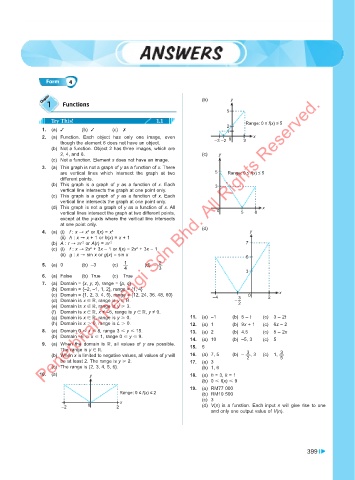
                    Try This!                         1.1                         Range: 0 ≤ f(x) ≤ 5
                                                                            2
                  1.  (a)  3  (b)  3    (c)  7                              1
                  2.  (a)  Function. Each object has only one image, even    0      x
                       though the element 6 does not have an object.    –3  –2   3
                    (b)  Not a function. Object 2 has three images, which are
                       2, 4, and 6.                                 (c)   y
                    (c)  Not a function. Element s does not have an image.
                  3.  (a)  This graph is not a graph of y as a function of x. There
                       are vertical lines which intersect the graph at two   5  Range: 0 ≤ f(x) ≤ 5
                       different points.
                    (b)  This graph is a graph of  y  as a function of  x. Each   3
                       vertical line intersects the graph at one point only.
                    (c)  This graph is a graph of  y as a function of  x. Each
                       vertical line intersects the graph at one point only.
                    (d)  This graph is not a graph of y as a function of x. All        x
                       vertical lines intersect the graph at two different points,   0  5  8
                       except at the y-axis where the vertical line intersects
                       at one point only.
                                                                    (d)
                                3
                  4.  (a)  (i)  f : x → x  or f(x) = x 3                           y
                       (ii)  h : x → x + 1 or h(x) = x + 1
                    (b)  A : r → πr  or A(r) = πr                                 7
                                       2
                              2
                                               2
                    (c)  (i)  f : x → 2x  + 3x – 1 or f(x) = 2x  + 3x – 1
                                 2
                       (ii)  g : x → sin x or g(x) = sin x                        5
                                           1
                                                      2
                  5.  (a)  0   (b)  –3   (c)  —   (d)  – —
                                           4          3
                                                                                  3
                  6.  (a)  False   (b)  True   (c)  True
                  7.  (a)  Domain = {x, y, z}, range = {p, q}
                    (b)  Domain = {–2, –1, 1, 2}, range = {1, 4}
                    (c)  Domain = {1, 2, 3, 4, 5}, range = {12, 24, 36, 48, 60}  –4  3  0  2  x
                    (d)  Domain is x ∈ , range is y ∈ .                     – – 2
                    (e)  Domain is x ∈ , range is y > 3.
                    (f)  Domain is x ∈ , x ≠ –5, range is y ∈ , y ≠ 0.
                    (g)  Domain is x ∈ , range is y > 0.        11.  (a)  –1   (b)  5 – t    (c)  3 – 2t
                    (h)  Domain is x . 0, range is L . 0.        12.  (a)  1   (b)  9x + 1   (c)  6z – 2
                  8.  (a)  Domain 0 < x < 8, range 3 < y < 15.   13.  (a)  2   (b)  4.5   (c)  5 – 2x
                    (b)  Domain –6 < x < 1, range 0 < y < 9.
                                                                 14.  (a)  10   (b)  –5, 3   (c)  5
                  9.  (a)  When the domain is  , all values of  y are possible.    15.  5
                       The range is y ∈ .                                        3          3
                    (b)  When x is limited to negative values, all values of y will    16.  (a)  7, 5    (b)  – —, 3   (c)  1, —
                                                                                  2
                                                                                             5
                       be at least 2. The range is y > 2.        17.  (a)  3
                    (c)  The range is {2, 3, 4, 5, 6}.              (b)  1, 6
                 10.  (a)        y                               18.  (a)  h = 3, k = 1
                                                                    (b)  0 < f(x) < 9
                                                                 19.  (a)  RM77 000
                                          Range: 0 ≤ f(x) ≤ 2       (b)  RM10 500
                                                                    (c)  3
                                          x
                        –2      0        2                          (d)  V(n)  is a function. Each input  n  will give rise to  one
                                                                       and only one output value of V(n).
                                                                                                     399
   75   76   77   78   79   80   81   82