


Page 62 - DnD 5e - Xanathar's Guide to Everything
P. 62
THrs Is YouR LIFE
         The character creation rules in the Player's Handbook
         provide a ll the  information you need to define your cha r-
         acter in preparation for a life of adventuring. What they
         don't do is account for all the circumstances that shaped
        your character during the years between your birth and
         the s ta rt of your career as a  member of a class.
          What did your cha racter accomplis h or experience be-
         fore deciding to become an adventurer? What were the
         circums tances of your birth? How la rge  is your family,
         and what sorts of relationships do you have with your
         relatives? Which people were the greatest influences on
        you during your formative year s, for better or worse?
          To answer these questions and more, you can use
         the tables and the advice in this section to compose a
         well-developed backstory for your character-an auto-
         biography of sorts- that you can use to inform how you
         roleplay the character. Your DM can  draw from this ma-
         terial as the campaign proceeds, creating situations and
         scenarios that build off your previous life experiences.
         IDEAS,  NOT RULES
                          --------------
        Even though these pages are full of tables and die rolls,
         they don't make up a rules system- in fact, the opposite
         is true. You can use as much or as little of this material
         as you desire, and you can make decisions in any or-
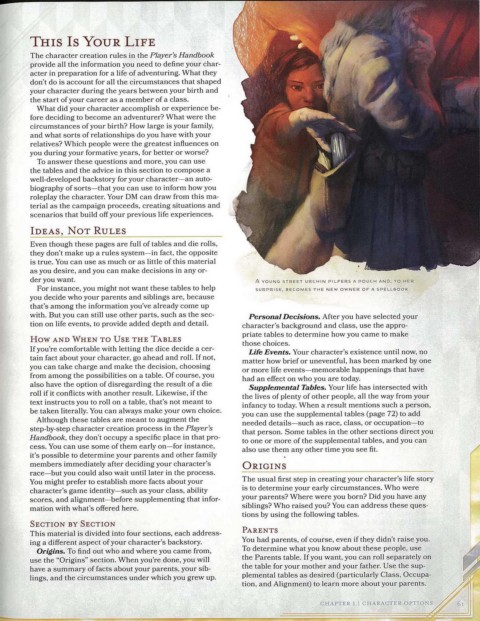
         der you want.                                            A YOUNG STREET  URCH I N  P I LFERS  A  P O UCH  ANO,  TO HER
          For instance, you might oot want these tables to help   SURPRISE,  BECO M ES  THE  N EW  OWN ER OF A  SPELLBOOI<
        you decide who your parents and siblings are, because
         that's among the information you've already come up
         with. But you can still use other parts, s uch as the sec-  Personal Decisions. After you have selected your
         tion on life events, to provide added depth a nd detail.   cha racter's background and class, use the appro-
                                                               priate tables to determine how you came to make
         How AND WHEN TO USE THE TABLES
                                                               those choices.
         U you're comfortable with letting the dice decide a cer-
                                                                Life Events. Your character's existence until now, no
         tain fact about your character, go a head and roll. If not,
                                                               matter how brief or uneventful, has been marked by one
        you can take charge and make the decision, choos ing
                                                               or more life events-memorable happenings that have
        from among the possibilities on a table. Of course, you
                                                               had an effect on who you are today.
         also have the option of dis regarding the result of a die
                                                                 Supplemental Tables. Your life has intersected with
         roll if it conflicts w ith a nother result. Likewise, if the
                                                               the  lives of plenty of other people, all  the way from your
         text instructs you to roll on a  table, that's not meant to   infancy to today. When a  result mentions such a person,
         be taken literally. You can a lways make your own choice.
                                                               you can use the supplemental tables (page 72) to add
          Although these tables are meant to augment the
                                                               needed details- s uch as race, class, or occupation- to
        s tep-by-step character creation process in the Player's
                                                               that person. Some tables in the other sections direct you
         Handbook, they don't occupy a specific place in that pro-
                                                               to one or more of the s upplemental tables, and you can
        cess. You can use some of them early on- for instance,
                                                               also use them any other time you see fit.
         it's possible to determine your parents and other family
         members  immediately after deciding your character's   ORIGINS
         race-but you could also wait until later in the process.         -------
                                                               The usual first step in creating your character's life s tory
        You might prefer to establis h more facts about your
        character's game identity-such as your class, ability   is  to determine your early circums tances. W ho were
                                                               your parents? Where were you born? Did you have any
        scores, and alignment- before s upplementing that infor-
         mation w ith what's offered here.                     siblings? Who raised you? You can address these ques-
                                                               tions by using the following tables.
         SECTION BY SECTION
        This material is divided into four sections, each address-  PARENTS
         ing a different aspect of your cha racter's backstory.   You had pa rents, of course, even if they didn't raise you.
                                                               To determine what you know about these people, use
          Origins. To find out who and where you came from,
                                                               the Parents table. If you want, you can roll separately on
         use the "Origins" section. When you're done, you will
         have a summary of facts about your parents, your sib-  the table for your mother and your father. Use the s up-
                                                               plemental tables as desired (particularly Class, Occupa-
         lings, a nd the circumstances under which you grew up.
                                                               tion, and Alignment) to learn more about your parents.
                                                                                   CHAPTER 1  I CHARACTER OPTTONS

