


Page 24 - 60x80_Fall2016_FOR_FLIPBOOK_Neat
P. 24
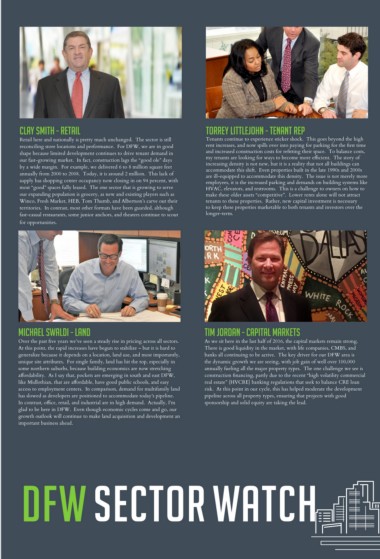
CLAY SMITH - RETAIL                                                               TORREY LITTLEJOHN - TENANT REP

Retail here and nationally is pretty much unchanged. The sector is still          Tenants continue to experience sticker shock. This goes beyond the high
reconciling store locations and performance. For DFW, we are in good              rent increases, and now spills over into paying for parking for the first time
shape because limited development continues to drive tenant demand in             and increased construction costs for refitting their space. To balance costs,
our fast-growing market. In fact, construction lags the “good ole” days           my tenants are looking for ways to become more efficient. The story of
by a wide margin. For example, we delivered 6 to 8 million square feet            increasing density is not new, but it is a reality that not all buildings can
annually from 2000 to 2008. Today, it is around 2 million. This lack of           accommodate this shift. Even properties built in the late 1990s and 2000s
supply has shopping center occupancy now closing in on 94 percent, with           are ill-equipped to accommodate this density. The issue is not merely more
most “good” spaces fully leased. The one sector that is growing to serve          employees, it is the increased parking and demands on building systems like
our expanding population is grocery, as new and existing players such as          HVAC, elevators, and restrooms. This is a challenge to owners on how to
Winco, Fresh Market, HEB, Tom Thumb, and Albertson’s carve out their              make these older assets “competitive”. Lower rents alone will not attract
territories. In contrast, most other formats have been guarded, although          tenants to these properties. Rather, new capital investment is necessary
fast-casual restaurants, some junior anchors, and theaters continue to scout      to keep these properties marketable to both tenants and investors over the
                                                                                  longer-term.
for opportunities.

MICHAEL SWALDI - LAND                                                             TIM JORDAN - CAPITAL MARKETS

Over the past five years we’ve seen a steady rise in pricing across all sectors.  As we sit here in the last half of 2016, the capital markets remain strong.
At this point, the rapid increases have begun to stabilize – but it is hard to    There is good liquidity in the market, with life companies, CMBS, and
generalize because it depends on a location, land use, and most importantly,      banks all continuing to be active. The key driver for our DFW area is
unique site attributes. For single family, land has hit the top, especially in    the dynamic growth we are seeing, with job gain of well over 100,000
some northern suburbs, because building economics are now stretching              annually fueling all the major property types. The one challenge we see is
affordability. As I say that, pockets are emerging in south and east DFW,         construction financing, partly due to the recent “high volatility commercial
like Midlothian, that are affordable, have good public schools, and easy          real estate” (HVCRE) banking regulations that seek to balance CRE loan
access to employment centers. In comparison, demand for multifamily land          risk. At this point in our cycle, this has helped moderate the development
has slowed as developers are positioned to accommodate today’s pipeline.          pipeline across all property types, ensuring that projects with good
In contrast, office, retail, and industrial are in high demand. Actually, I’m     sponsorship and solid equity are taking the lead.
glad to be here in DFW. Even though economic cycles come and go, our
growth outlook will continue to make land acquisition and development an
important business ahead.

dfw sector watch
    24

