


Page 251 - English Lesson Plan Year 3
P. 251
Primary Year 3 SK Scheme of Work
 SCHEME OF WORK: NON-TEXTBOOK BASED LESSON (Unit 6)

 LESSON: 90 (Language Arts 17)   MAIN SKILL(S) FOCUS: Language Arts   THEME: World of Self, Family and Friends
 WEEK:   TOPIC: Food, please!   CROSS-CURRICULAR ELEMENT: Creativity and   LANGUAGE/GRAMMAR FOCUS: Food vocabulary

 Innovation


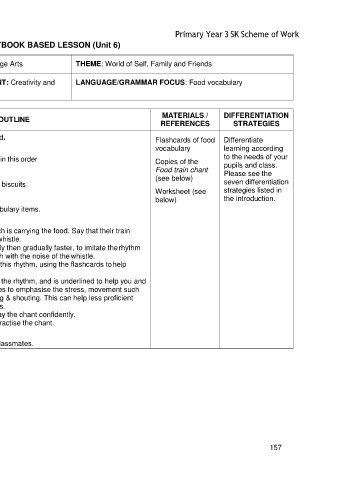
 CONTENT   LEARNING                      MATERIALS /     DIFFERENTIATION
 STANDARD   STANDARD   LEARNING OUTLINE   REFERENCES       STRATEGIES
       In this lesson, pupils will create a chant about food.
 Main Skill   Main Skill                Flashcards of food  Differentiate
 Language Arts 5.3  Language Arts   Pre-lesson   vocabulary   learning according
 Express an   5.3.1   1.  Put food vocabulary flashcards on the board in this order   Copies of the   to the needs of your
 imaginative   Respond   i.   Line 1: sugar   Food train chant   pupils and class.
 response to   imaginatively and   ii.   Line 2: peas and pineapple   (see below)   Please see the
 literary texts   intelligibly through   iii.   Line 3: coconuts and chocolate biscuits   seven differentiation
    creating simple   iv.   Line 4: milk and flour   Worksheet (see   strategies listed in
    action songs on   v.   Line 5: cheese   below)       the introduction.
    familiar topics.   2.  Point to the cards and ask pupils to say vocabulary items.
    Other imaginative   Lesson delivery
    responses as   3.  Tell pupils that they are on a steam train which is carrying the food. Say that their train
 appropriate.
       starts slowly, gets faster, and finally gives a whistle.
 Complementary   Complementary   4.  Ask pupils to stand up. Move your arms slowly then gradually faster, to imitate the rhythm
 of the train, and ask pupils to copy you. Finish with the noise of the whistle.
 Skill   Skill   5.  Now say the Food train chant (see below) to this rhythm, using the flashcards to help
 Speaking   Speaking   pupils remember the words if necessary.
 2.3   2.3.1   The stress on the words is very important for the rhythm, and is underlined to help you and
 Communicate   Narrate very short   the pupils. You can use hand or body gestures to emphasise the stress, movement such
 appropriately to a   basic stories and   as jumping on a stressed sound or whispering & shouting. This can help less proficient
 small or large   events   pupils identify and practice the stress patterns.
 group
 Practise two or three times until pupils can say the chant confidently.
 6.  Put pupils into groups of 3–4. Ask pupils to practise the chant.
 Post-lesson
 7.  Ask groups to perform their chants for their classmates.
 Worksheet for Lesson 90
 Food train chant
 (idea from Young Learners, (1993), (p104) Phillips, S Oxford University Press
 Sugar,   sugar
 Peas and pineapple, peas and pineapple,
 Coconuts and chocolate biscuits, Coconuts and chocolate biscuits,
 Milk and flour, milk and flour,
 CHEESE!
 CH-E-E-E-E-E-E-SE!

                                                                    157

