


Page 294 - English Lesson Plan Year 3
P. 294
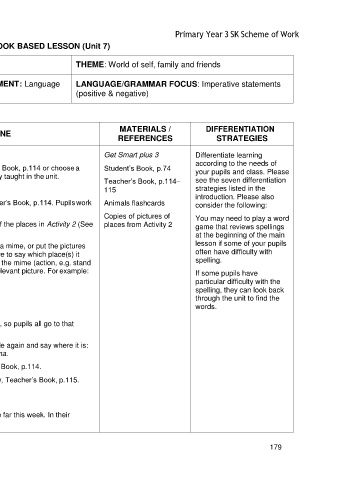
Primary Year 3 SK Scheme of Work
 SCHEME OF WORK: TEXTBOOK BASED LESSON (Unit 7)

 LESSON: 110 (Writing 21)   MAIN SKILL FOCUS: Writing   THEME: World of self, family and friends
 WEEK:   TOPIC: Out and about   CROSS-CURRICULAR ELEMENT: Language   LANGUAGE/GRAMMAR FOCUS: Imperative statements

                    (positive & negative)


 CONTENT   LEARNING            MATERIALS /          DIFFERENTIATION
 STANDARD   STANDARD   LEARNING OUTLINE   REFERENCES   STRATEGIES

 Main Skill   Main Skill   Pre-lesson   Get Smart plus 3   Differentiate learning
 Writing 4.3   Writing 4.3.2   1.  Play Thief! game from Warm up, Teacher’s Book, p.114 or choose a   Student’s Book, p.74   according to the needs of
 Communicate   Spell an increased   suitable activity to review animal vocabulary taught in the unit.   your pupils and class. Please
 with appropriate   range of familiar   Teacher’s Book, p.114–   see the seven differentiation
 language form   high frequency   Lesson delivery   115   strategies listed in the
 and style for a   words accurately in   2.  Follow the instructions for Activity 1, Teacher’s Book, p.114. Pupils work   Animals flashcards   introduction. Please also
 range of purposes   guided writing   in pairs on this activity.   consider the following:
 in print and digital      Copies of pictures of   You may need to play a word
 media   3.  Use the picture copies to elicit the names of the places in Activity 2 (See   places from Activity 2   game that reviews spellings
    Complementary   Student’s Book p.74).         at the beginning of the main
 Skill                                            lesson if some of your pupils
 Complementary   Listening 1.2.2   4.  Give each place a number/letter, or assign a mime, or put the pictures   often have difficulty with
 around the room. Say a rule and pupils have to say which place(s) it
 Skill   Understand with   refers to by saying the number/letter, doing the mime (action, e.g. stand   spelling.
 Listening 1.2   support specific   up/sit down/turn around), or touching the relevant picture. For example:
 Understand   information and                     If some pupils have
 meaning in a   details of short   Teacher: Turn off your mobile phone   particular difficulty with the
 variety of familiar   simple texts               spelling, they can look back
 contexts   Cinema = A, so pupils say A           through the unit to find the
 Cinema = stand up, so pupils stand up            words.
 Cinema = the picture next to the board, so pupils all go to that
 picture and touch it.
 Each time, ask the pupils to say the rule again and say where it is:
 Turn of your mobile phone in the cinema.
 5.  Follow instructions for Activity 2, Teacher’s Book, p.114.
 6.  (If time) Play Hot card (see Optional activity, Teacher’s Book, p.115.
 Post-lesson
 7.  Learning diaries:
 Ask pupils to think back on their learning so far this week. In their
 learning diary, they can write:


                                                                    179

