


Page 370 - English Lesson Plan Year 3
P. 370
Primary Year 3 SK Scheme of Work
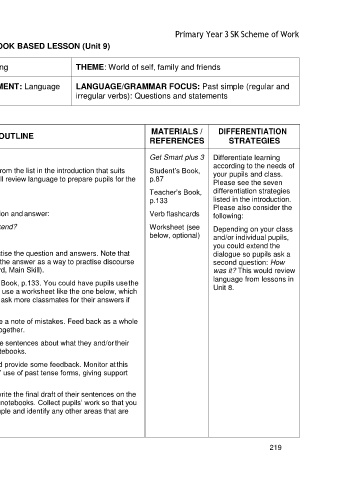
 SCHEME OF WORK: TEXTBOOK BASED LESSON (Unit 9)

 LESSON: 135 (Speaking 26)   MAIN SKILL FOCUS: Speaking   THEME: World of self, family and friends
 WEEK:   TOPIC: On holiday   CROSS-CURRICULAR ELEMENT: Language   LANGUAGE/GRAMMAR FOCUS: Past simple (regular and

                    irregular verbs): Questions and statements


 CONTENT   LEARNING                    MATERIALS /     DIFFERENTIATION
 STANDARD   STANDARD   LEARNING OUTLINE   REFERENCES      STRATEGIES

 Main Skill   Main Skill   Pre-lesson   Get Smart plus 3   Differentiate learning
 Speaking 2.2 Use   Speaking 2.2.1   1.  Choose an appropriate pre-lesson activity from the list in the introduction that suits   Student’s Book,   according to the needs of
 appropriate   Keep interaction   your pupils’ needs and interests and that will review language to prepare pupils for the   p.87   your pupils and class.
 communication   going in short   lesson.             Please see the seven
 strategies   exchanges by            Teacher’s Book,   differentiation strategies
    repeating key words   Lesson delivery   p.133     listed in the introduction.
 from the other   2.  Using the verb flashcards, model the question and answer:   Verb flashcards   Please also consider the
 Complementary   speaker                              following:
 Skill      Question: What did you do at the weekend?   Worksheet (see   Depending on your class
 Writing 4.3      Answer: At the weekend? I xxx.   below, optional)   and/or individual pupils,
 Communicate   Complementary                          you could extend the
 with appropriate   Skill   3.  Use the verb flashcards to have pupils practise the question and answers. Note that   dialogue so pupils ask a
 language form   Writing 4.3.3   pupils are repeating the time expression in the answer as a way to practise discourse   second question: How
 and style for a   Plan, draft and write   and interaction skills (see Learning Standard, Main Skill).   was it? This would review
 range of purposes   an increased range               language from lessons in
 in print and digital   of simple sentences   4.  Follow instructions for Activity 4, Teacher’s Book, p.133. You could have pupils use the   Unit 8.
 media   table on Student’s Book, p.87, or you could use a worksheet like the one below, which
 is a little more pupil-friendly. They can also ask more classmates for their answers if
 there is time.
 Monitor carefully as pupils do this and make a note of mistakes. Feed back as a whole
 class and focus on the common mistakes together.
 5.  To follow up, ask pupils to write one or more sentences about what they and/or their
 classmate(s) did at the weekend in their notebooks.
 6.  Ask pupils to check their partner’s work and provide some feedback. Monitor at this
 stage and the previous one to check pupils’ use of past tense forms, giving support
 and praise where needed.
 7.  If you are using the worksheet, pupils can write the final draft of their sentences on the
 worksheet. If not, pupils can write it in their notebooks. Collect pupils’ work so that you
 can review their progress in use of past simple and identify any other areas that are
 causing problems.
 Post-lesson

                                                                    219

