


Page 419 - English Lesson Plan Year 3
P. 419
Primary Year 3 SK Scheme of Work
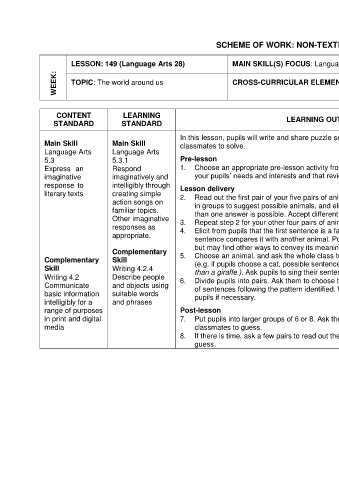
                                                       SCHEME OF WORK: NON-TEXTBOOK BASED LESSON (Unit 10)

                   LESSON: 149 (Language Arts 28)          MAIN SKILL(S) FOCUS: Language Arts           THEME: World of Knowledge
               WEEK:   TOPIC: The world around us          CROSS-CURRICULAR ELEMENT: Entrepreneurship   LANGUAGE/GRAMMAR FOCUS: Comparative adjectives, animal

                                                                                                        vocabulary


               CONTENT          LEARNING                                                                                    MATERIALS /        DIFFERENTIATION
              STANDARD         STANDARD                                 LEARNING OUTLINE                                   REFERENCES            STRATEGIES
                                              In this lesson, pupils will write and share puzzle sentences about animals for their
            Main Skill       Main Skill       classmates to solve.                                                     Five pairs of sentences   Differentiate
            Language Arts    Language Arts                                                                             which describe an animal:   learning according
            5.3              5.3.1            Pre-lesson                                                               1. They live in the sea.   to the needs of your
            Express  an      Respond          1.  Choose an appropriate pre-lesson activity from the list in the introduction that suits   They’re  bigger  than   pupils and class.
            imaginative      imaginatively and   your pupils’ needs and interests and that reviews animals and adjectives.   dolphins.         Please see the
            response  to     intelligibly through   Lesson delivery                                                    2. They’ve got four legs.   seven differentiation
            literary texts   creating simple   2.  Read out the first pair of your five pairs of animal description sentences. Ask pupils   They’re faster than dogs.   strategies listed in
                             action songs on     in groups to suggest possible animals, and elicit their suggestions. Sometimes more   3. They like cheese. They   the introduction.
                             familiar topics.    than one answer is possible. Accept different answers.                 are smaller than rats.
                             Other imaginative   3.  Repeat step 2 for your other four pairs of animal sentences.      4. They are black and
                             responses as     4.  Elicit from pupils that the first sentence is a fact about the animal, and the second   white. They are bigger
                               appropriate.      sentence compares it with another animal. Pupils may not use the word ‘compare’   than rats.
                             Complementary       but may find other ways to convey its meaning.                        5. They are grey. They are
                                                                                                                        fatter than cats.
            Complementary    Skill            5.  Choose an animal, and ask the whole class to suggest two possible sentences for it
                                                 (e.g. if pupils choose a cat, possible sentences might be: It likes milk. It’s shorter
            Skill            Writing 4.2.4       than a giraffe.). Ask pupils to sing their sentences and mime.        Possible answers include
            Writing 4.2      Describe people   6.  Divide pupils into pairs. Ask them to choose two different animals and to write pairs   1. Blue whales
            Communicate      and objects using   of sentences following the pattern identified. Write the patterns on the board to help   2. Lions, tigers, cheetahs
            basic information   suitable words   pupils if necessary.                                                  3. Mice
            intelligibly for a   and phrases                                                                           4. Zebras
            range of purposes                 Post-lesson                                                              5. Hippos
            in print and digital              7.  Put pupils into larger groups of 6 or 8. Ask them to read out their sentences for their
            media                                classmates to guess.
                                              8.  If there is time, ask a few pairs to read out their sentences for the whole class to
                                                 guess.


                                                                                                                                                        245

