


Page 421 - English Lesson Plan Year 3
P. 421
Primary Year 3 SK Scheme of Work
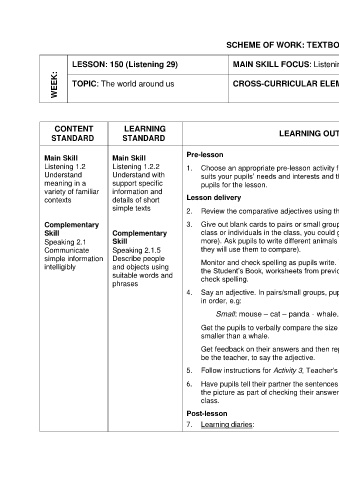
                                                         SCHEME OF WORK: TEXTBOOK BASED LESSON (Unit 10)

                   LESSON: 150 (Listening 29)              MAIN SKILL FOCUS: Listening                  THEME: World of Knowledge
               WEEK:   TOPIC: The world around us          CROSS-CURRICULAR ELEMENT: Language           LANGUAGE/GRAMMAR FOCUS: Comparatives: Short

                                                                                                        adjectives; Statements


               CONTENT          LEARNING                                                                               MATERIALS /         DIFFERENTIATION
              STANDARD         STANDARD                               LEARNING OUTLINE                                 REFERENCES             STRATEGIES

            Main Skill       Main Skill        Pre-lesson                                                          Get Smart plus 3       Differentiate learning
            Listening 1.2    Listening 1.2.2   1.  Choose an appropriate pre-lesson activity from the list in the introduction that   Student’s Book, p.97   according to the needs of
            Understand       Understand with       suits your pupils’ needs and interests and that will review language to prepare        your pupils and class.
            meaning in a     support specific      pupils for the lesson.                                          Teacher’s Book, p.147   Please see the seven
            variety of familiar   information and                                                                  Animals flashcards     differentiation strategies
            contexts         details of short   Lesson delivery                                                                           listed in the introduction.
                             simple texts      2.  Review the comparative adjectives using the animals flashcards.   Blank cards (five or six   Please also consider the
                                                                                                                   per pair/small group)   following:
            Complementary                      3.  Give out blank cards to pairs or small groups of pupils. Depending on your             You could have pupils
            Skill            Complementary         class or individuals in the class, you could give them five or six cards (or           make more or fewer
            Speaking 2.1     Skill                 more). Ask pupils to write different animals on each card (in plural form as           cards. This would give
            Communicate      Speaking 2.1.5        they will use them to compare).                                                        more/fewer words to spell
            simple information  Describe people    Monitor and check spelling as pupils write. You could encourage them to use            and write, and also make
            intelligibly     and objects using     the Student’s Book, worksheets from previous lessons, or a dictionary to               the ordering task
                             suitable words and    check spelling.                                                                        more/less challenging.
                             phrases
                                               4.  Say an adjective. In pairs/small groups, pupils listen and arrange their animals
                                                   in order, e.g:
                                                       Small: mouse – cat – panda – whale.
                                                   Get the pupils to verbally compare the size of the animals: e.g. a panda is
                                                   smaller than a whale.

                                                   Get feedback on their answers and then repeat. You could ask some pupils to
                                                   be the teacher, to say the adjective.
                                               5.  Follow instructions for Activity 3, Teacher’s Book, p.147.
                                               6.  Have pupils tell their partner the sentences to describe the people/animals in
                                                   the picture as part of checking their answers together. Then check as a whole
                                                   class.
                                               Post-lesson
                                               7.  Learning diaries:


                                                                                                                                                        246

