


Page 141 - Jeddonian 2018-19
P. 141
Geography


        Geography at JPGS is the study of places and the      papers that are examined at the end of year 11. Students
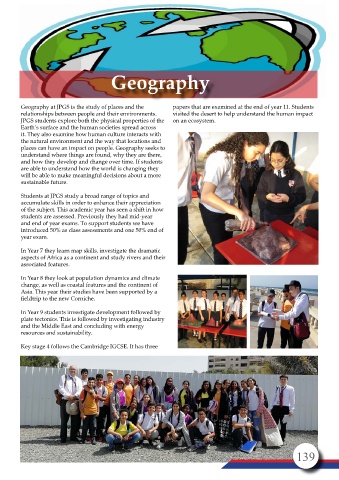
        relationships between people and their environments.   visited the desert to help understand the human impact
        JPGS students explore both the physical properties of the   on an ecosystem.
        Earth’s surface and the human societies spread across
        it. They also examine how human culture interacts with
        the natural environment and the way that locations and
        places can have an impact on people. Geography seeks to
        understand where things are found, why they are there,
        and how they develop and change over time. If students
        are able to understand how the world is changing they
        will be able to make meaningful decisions about a more
        sustainable future.

        Students at JPGS study a broad range of topics and
        accumulate skills in order to enhance their appreciation
        of the subject. This academic year has seen a shift in how
        students are assessed. Previously they had mid-year
        and end of year exams. To support students we have
        introduced 50% as class assessments and one 50% end of
        year exam.

        In Year 7 they learn map skills, investigate the dramatic
        aspects of Africa as a continent and study rivers and their
        associated features.

        In Year 8 they look at population dynamics and climate
        change, as well as coastal features and the continent of
        Asia. This year their studies have been supported by a
        fieldtrip to the new Corniche.


        In Year 9 students investigate development followed by
        plate tectonics. This is followed by investigating industry
        and the Middle East and concluding with energy
        resources and sustainability.

        Key stage 4 follows the Cambridge IGCSE. It has three


                                                                                                         139

